
The Gila monster helped inspire one GLP-1 medicine—but not every medication in the class. A peptide called exendin-4, isolated from Gila monster venom, led to the development of exenatide. The animal does not produce the drug exenatide, and exendin-4 is not the direct basis of semaglutide (Ozempic) or tirzepatide (Mounjaro).
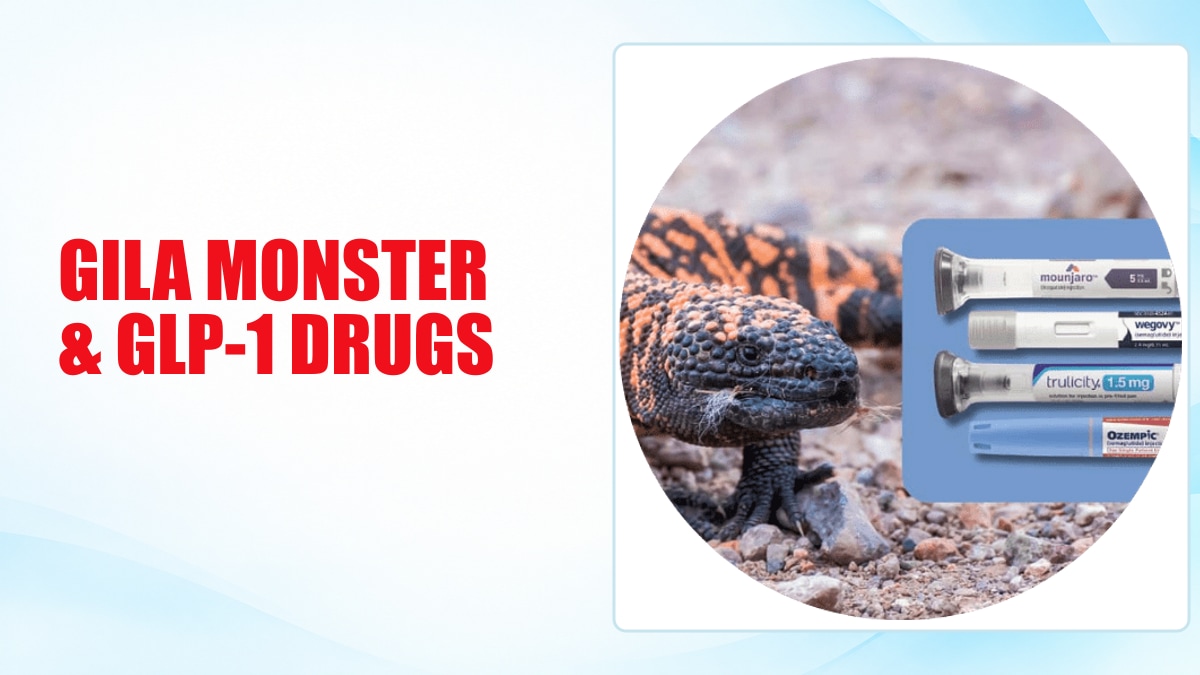
That distinction matters because the real story is more interesting and more accurate than the popular claim that all modern GLP-1 drugs “come from Gila monster saliva.”
The Real Gila Monster–GLP-1 Connection
Human GLP-1 is an incretin hormone involved in glucose-dependent insulin secretion, glucagon regulation, gastric emptying, and appetite. Its activity in the body is brief because it is rapidly broken down.
Researchers studying Gila monster venom identified exendin-4, a peptide that activates the human GLP-1 receptor and lasts longer than native GLP-1. Synthetic exendin-4 became exenatide, approved in the United States as Byetta in 2005. A history of exenatide’s development describes that path, and the current FDA prescribing information for Byetta identifies exenatide as a GLP-1 receptor agonist.
Ozempic and Mounjaro Are Different Molecules
Exenatide opened an important door, but newer incretin medications are not simply copies of the Gila monster peptide.
- Ozempic (semaglutide) is a GLP-1 receptor agonist designed as an analog of human GLP-1. The FDA label for Ozempic describes semaglutide as selectively binding to and activating the GLP-1 receptor.
- Mounjaro (tirzepatide) activates both GIP and GLP-1 receptors. Its FDA prescribing information describes a molecule based on the GIP sequence.
They belong to the same broad incretin-treatment story, but their molecular origins and receptor activity are not identical.
Do Ketogenic Diets “Mimic” GLP-1 Medications?
Not in a clinically interchangeable sense. A ketogenic diet can reduce hunger for some people, and a systematic review of ketogenic diets and appetite found small changes consistent with appetite suppression during energy restriction. But food patterns do not deliver a standardized drug dose, and they do not reproduce a medication’s pharmacology, effectiveness, adverse effects, or monitoring needs.
Intermittent fasting is also not a medication equivalent. A meta-analysis of 17 randomized trials found no clear appetite advantage for intermittent fasting compared with continuous energy restriction.
Nutrition, physical activity, sleep, behavioral support, and medication can all be tools. They are not moral opposites, and needing medication is not evidence that someone “failed” at lifestyle change.
What GLP-1 Medications Can—and Cannot—Do
Incretin-based medications may help improve glycemic control and reduce food intake and body weight for appropriately selected patients. They also have contraindications, potential adverse effects, dosing considerations, and follow-up requirements. The right medication, if any, depends on the diagnosis, medical history, other treatments, goals, access, and informed preference.
Medication can reduce appetite, but it does not automatically build a durable eating pattern, preserve strength, address food-related distress, or create a plan for what happens if treatment changes. Those needs are why clinical care, nutrition, coaching, and resistance training may be used together.
A Better Lesson From the Gila Monster
The useful lesson is that careful biological research can reveal a useful pathway. Later therapies can build on that discovery in different ways. It does not mean that one animal supplied every modern GLP-1 drug.
Considering GLP-1 treatment or planning for a transition? Explore Toward Health’s medical weight loss program and GLP-1 Off-Ramp.