
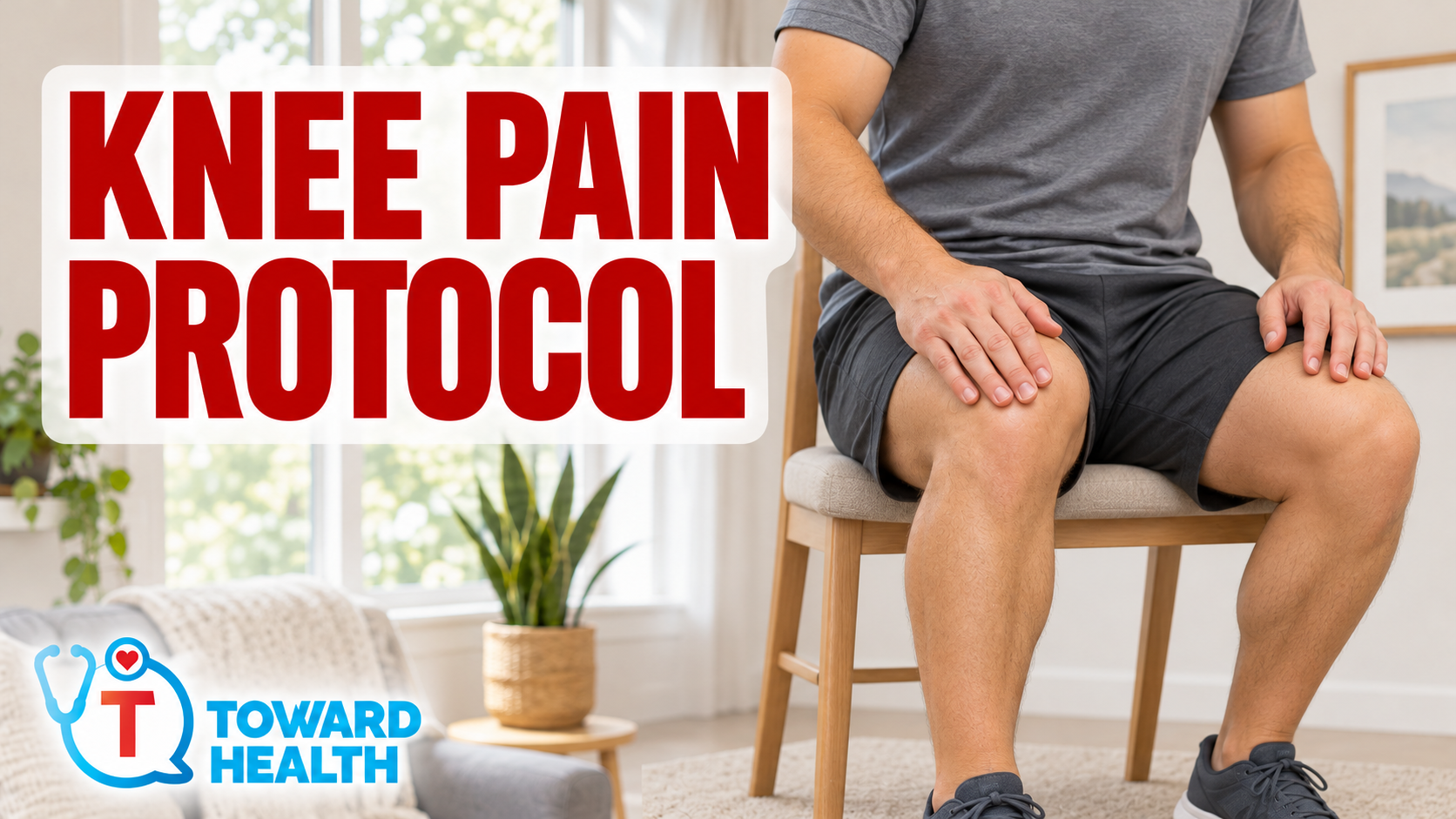
When your knee hurts, stairs, walking and getting out of a chair can become harder. The aim of this protocol is to rebuild comfortable movement, strength and confidence through small, repeatable steps. The six core sections cover reverse walking, tibialis raises, a heel-flat Patrick step, a supported split squat, calf raises and hamstring curls.
Start with the version you can control without pain. Use support, keep the movement small and progress according to your response. A deeper squat is optional; making everyday activity easier is the goal.
Who this protocol is for
This plan is for adults with stable, nontraumatic knee pain who have been assessed as suitable for exercise. Common examples include patellofemoral pain, often felt around or behind the kneecap, and knee osteoarthritis. Your clinician may adjust the exercises or add hip strengthening after examining you.
A recent major injury, surgery, repeated giving way or existing activity restrictions needs an individualized plan. New or worsening symptoms deserve assessment rather than simply harder exercise.
Let comfort and control guide you
- Begin pain-free. Use more support, a smaller range or fewer repetitions. Stop for sharp pain, catching, instability or a new limp.
- Check the next morning. Your knee should be back to its usual baseline without extra swelling. If it is worse, reduce the next session and return to an easier version.
- Change one thing at a time. After two or three comfortable sessions with a normal next-morning response, add a few repetitions, a little range or a small amount of resistance.
The doses below are suggested starting ranges, not targets you must reach. Begin below them if needed. Strength work fits into two or three nonconsecutive days each week, with rest between sets. Brief reverse walking can serve as your warm-up.
The six core exercise sections
1. Reverse walking
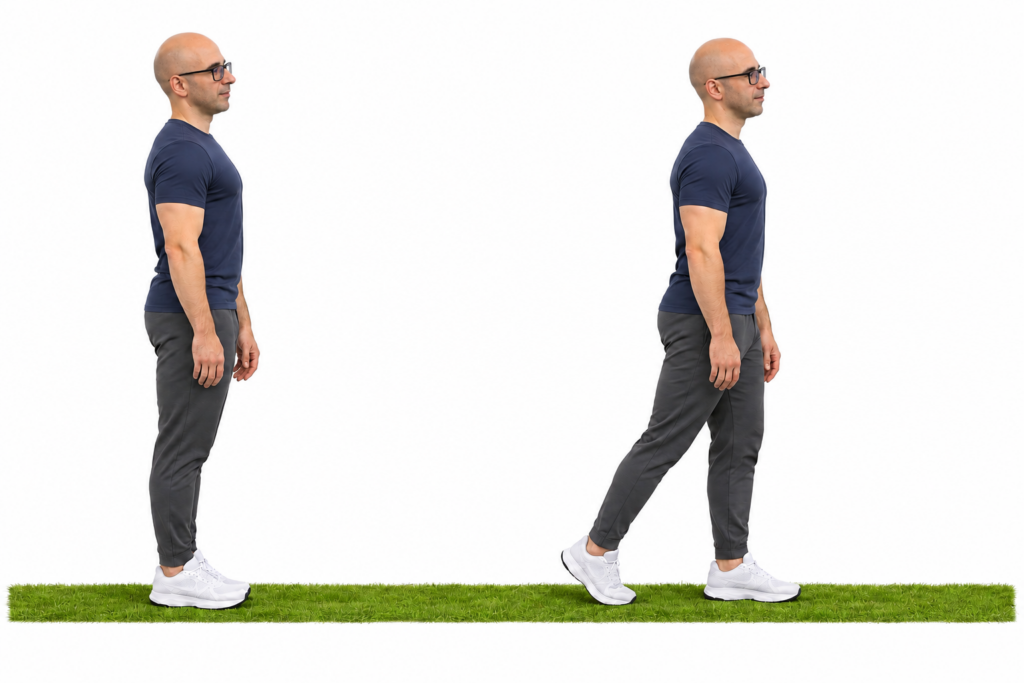
Choose a clear, level field or a treadmill set up for backward walking. On a field, check the route first. On a treadmill, use a low speed and get instruction or supervision for safe setup, starting and stopping. Stand upright with your arms relaxed and take slow, short backward steps.
Start: Three bouts of 30–60 seconds, resting between bouts.
Make it easier: Use shorter bouts and smaller steps. If balance is uncertain, ask your clinician about supervision or an alternative before trying backward walking.
Build: Increase total walking time before adding resistance. Work toward three to five minutes, then five to ten minutes if your knee remains comfortable.
2. Tibialis raises
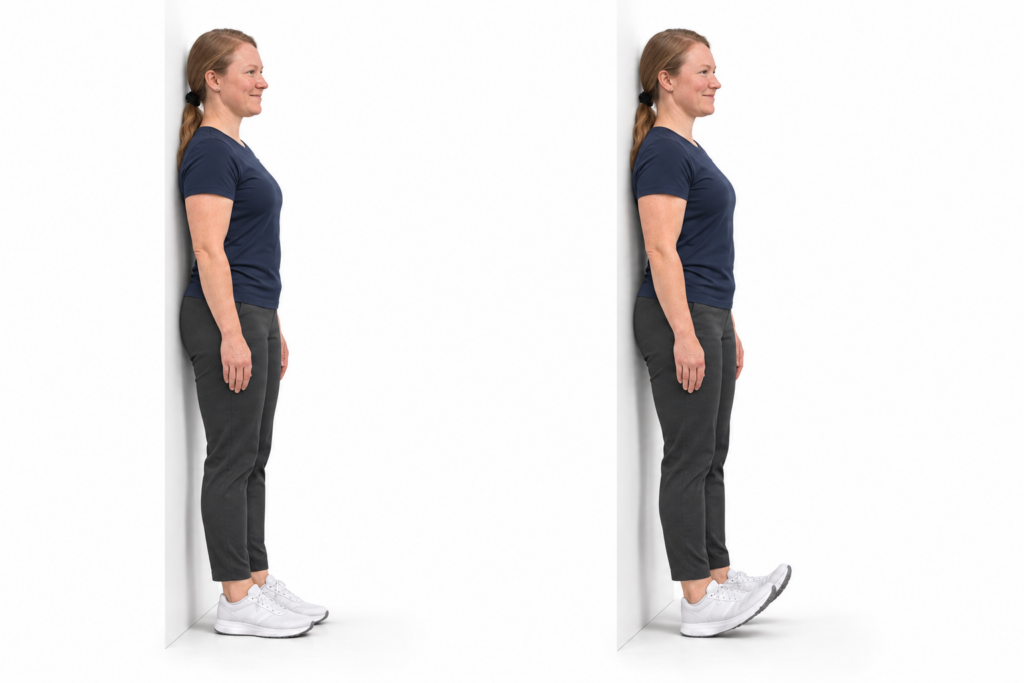
Lean your back against a wall with your feet a short distance forward. Keep both heels on the floor. Lift the fronts of your feet toward your shins, then lower slowly without bouncing.
Start: One or two sets of 8–12 repetitions.
Make it easier: Sit with your heels down and lift the fronts of your feet, or stand closer to the wall.
Build: Move your feet a little farther forward or gradually increase repetitions. Keep your heels grounded throughout.
3. Patrick step: the heel-flat version
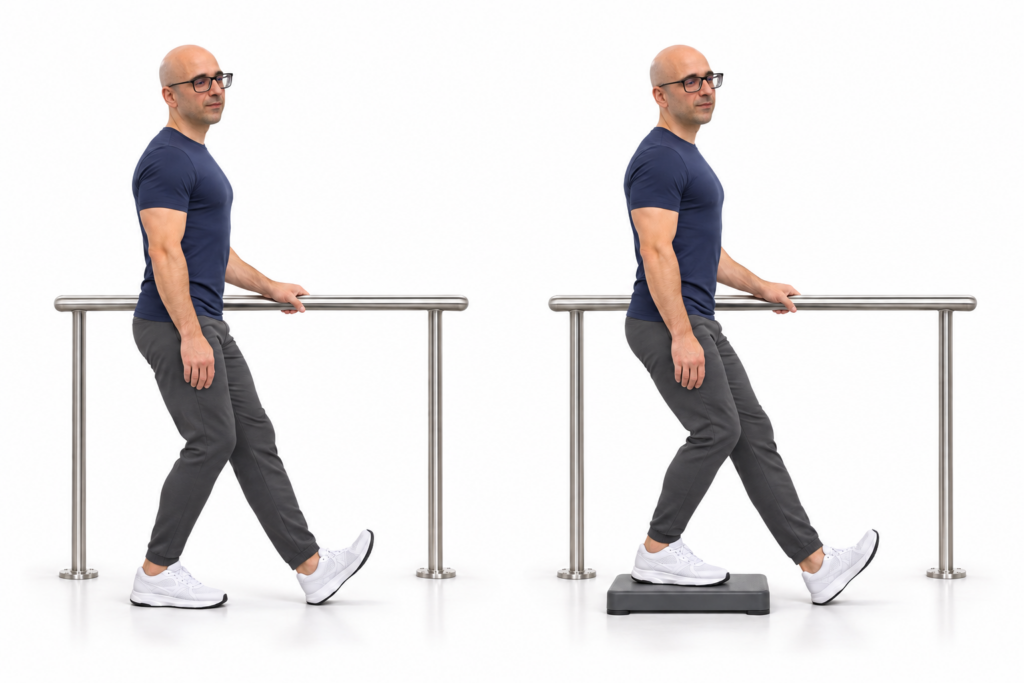
Hold a rail and stand on one leg. Bend that knee gently forward while the other heel reaches ahead and lightly taps the floor. Keep the supporting heel flat. Straighten using the supporting leg; avoid pushing off the tapping foot.
Start: On the floor, do one or two sets of five repetitions per side with a small, comfortable bend.
Make it easier: Use more hand support and less knee bend.
Build: Put the working foot on a very low, stable platform and tap the other heel to the floor ahead. Increase height only after comfortable sessions and a normal next-morning response. The working heel stays down; a heel-lifted step is a different variation.
4. Supported split squat: front foot elevated
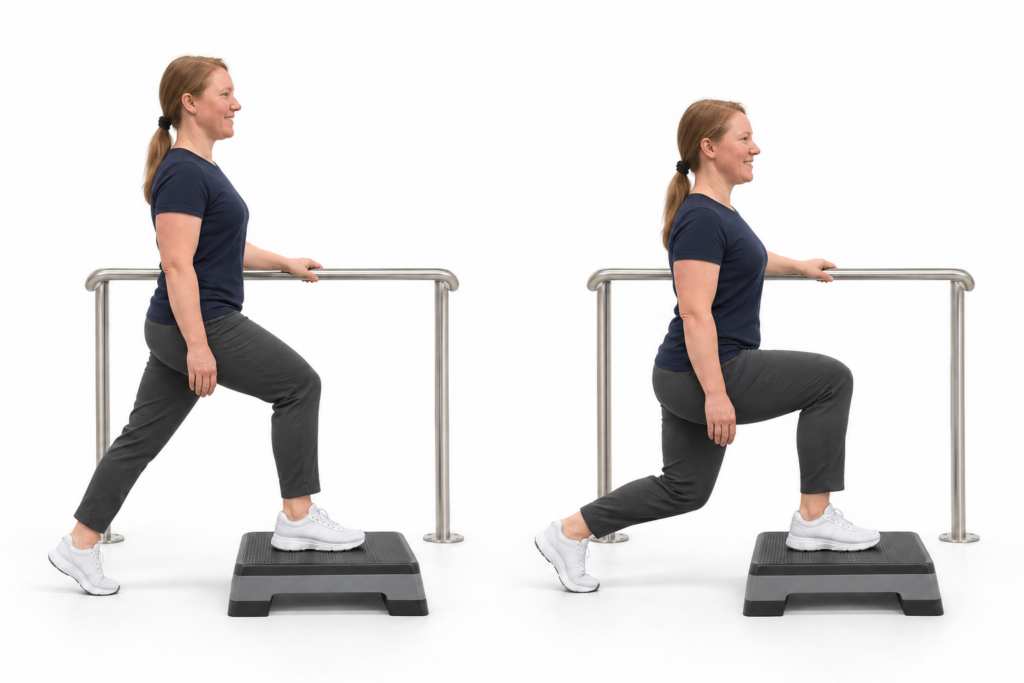
Place your whole front foot on a stable bottom stair or broad exercise platform. Keep the rear foot on the floor and hold a rail. From a comfortable split stance, lower slowly while the front knee moves in line with the toes and the front heel stays down. Push through the front foot to rise.
Start: One or two sets of five repetitions per side, using a shallow, supported range.
Make it easier: Use more hand support and less depth. Elevation alone does not guarantee less knee load.
Build: Gradually increase comfortable depth, reduce assistance and lower the front-foot support toward floor level. Add load last. A deep ATG split squat is an optional later progression, not a required endpoint.
5. Calf raises: straight-knee and bent-knee
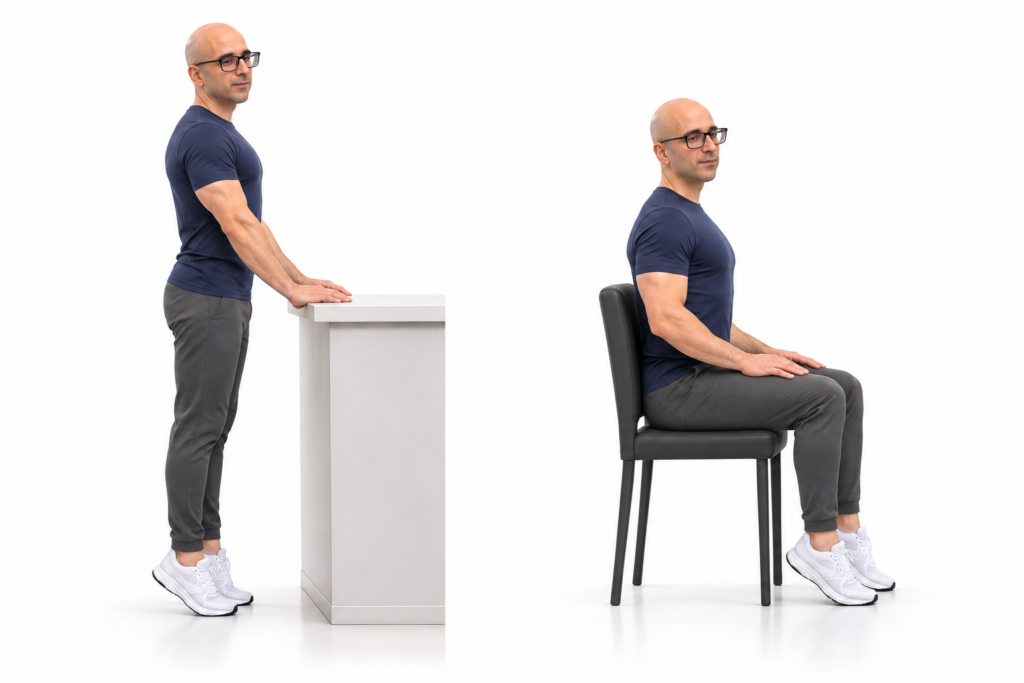
For the straight-knee version, hold a stable counter, keep your knees comfortably straight and rise onto the balls of both feet. Lower your heels slowly. For the bent-knee version, sit tall on a firm chair with your feet under your knees. Keep the fronts of your feet planted, lift your heels and lower them with control.
Start: One set of 8–12 repetitions of each comfortable version.
Make it easier: Use both legs, a smaller heel lift and more hand support for standing. Start with the seated version if standing is uncomfortable.
Build: Work toward two sets of 10–15. Then add a small amount of resistance or progress standing work toward one leg, changing only one variable. A lightly loaded seated raise or supported bent-knee standing raise can be a later option. Avoid bouncing or forcing a deep heel drop.
6. Supported hamstring curls
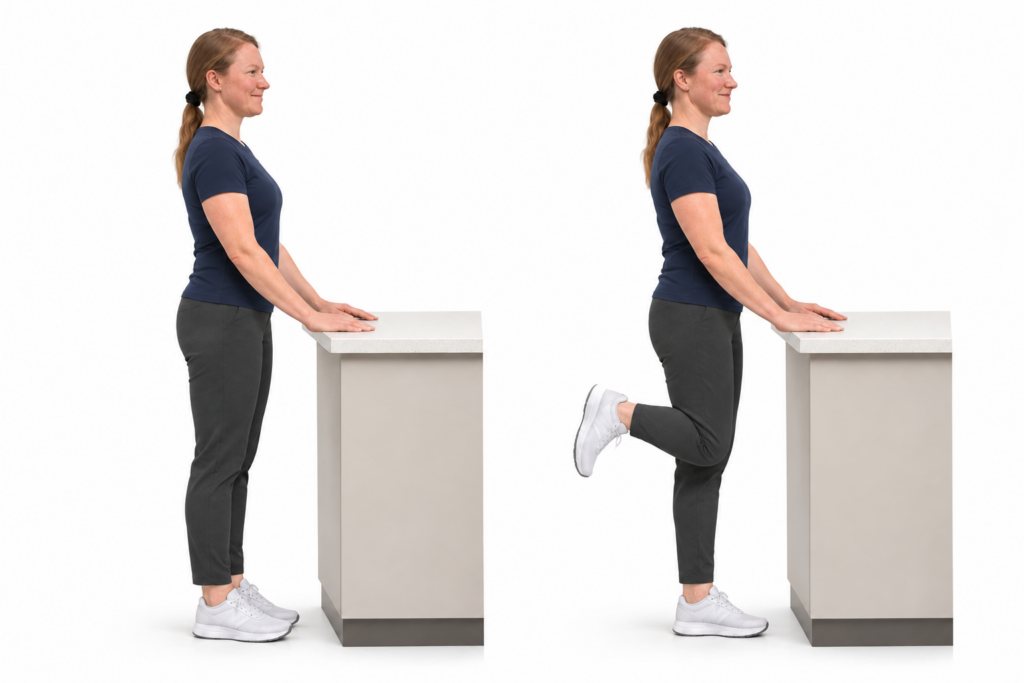
Stand tall holding a stable counter. Keep your thighs alongside one another and bend one knee to bring that heel behind you through a comfortable range. Lower slowly. Keep the pelvis still rather than arching your back or swinging the thigh forward.
Start: One set of 8–12 repetitions per side without added weight.
Make it easier: Use a smaller bend and fewer repetitions. If standing is not comfortable, ask your clinician to select a seated or lying version.
Build: Progress to two sets of 10–15 per side, then a light band, ankle weight or correctly adjusted hamstring-curl machine. An assisted Nordic is a separate advanced option; it is not the required next step.
Progress by response, not by the calendar
| Movement | Start | Build control | Build strength |
|---|---|---|---|
| Reverse walking | 3 × 30–60 seconds | 3–5 minutes total | 5–10 minutes total |
| Tibialis raises | 1–2 × 8–12 | 2 × 10–15 | 2–3 × 12–20 |
| Patrick step | Floor and support: 1–2 × 5 per side | Floor or low step: 2 × 6–10 per side | Low step: 2–3 × 8–12 per side |
| Split squat | Elevated, shallow: 1–2 × 5 per side | Supported: 2 × 6–8 per side | 2–3 × 6–10 per side; gradually lower support or add light load |
| Calf raises: each variant | 1 × 8–12 | 2 × 10–15 | Add light resistance or progress standing work toward one leg |
| Hamstring curls | 1 × 8–12 per side | 2 × 10–15 per side | Light band, ankle weight or machine |
Sets × repetitions are shown for the strength exercises. You can use different levels for different movements. Omit an exercise that cannot be made comfortable. Keep a simple record of your exercise version, dose and next-morning response, plus one everyday activity you want to improve.
Optional hip work and mobility
Choose additions that fit your assessment
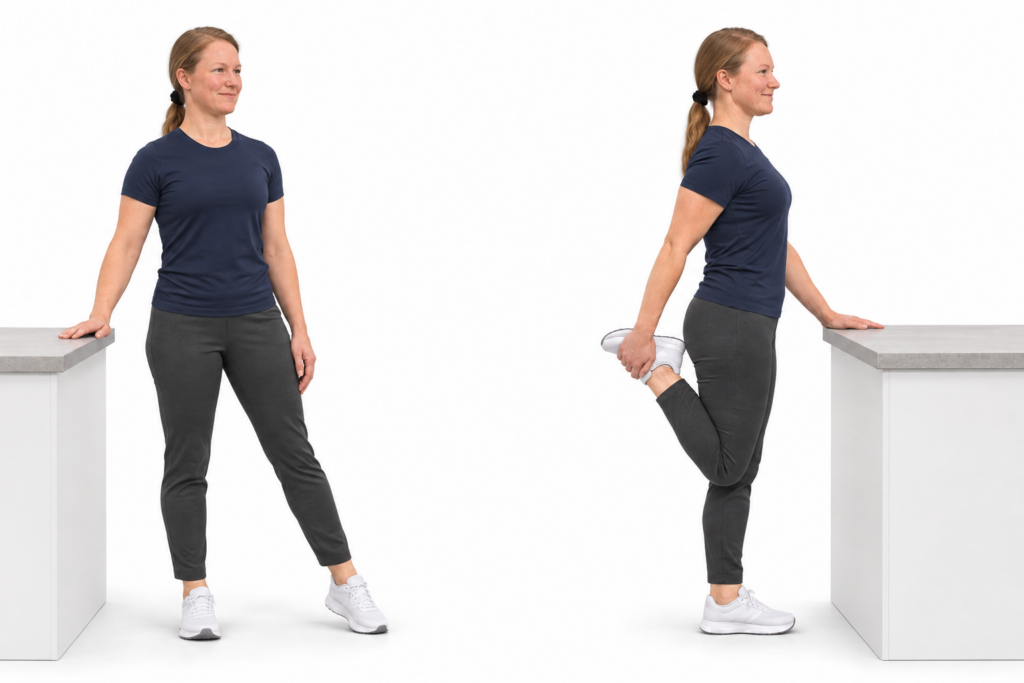
If your clinician identifies a reason to add hip strengthening, a supported standing hip abduction is one option: keep the trunk upright and toes forward, then move one leg a short distance sideways without leaning. Start with one set of 8–12 controlled repetitions per side. Add a second set before resistance if comfortable.
Use gentle calf, hamstring, quadriceps or hip-flexor stretching only where it helps a limited movement. Begin with one or two comfortable 20–30-second holds, without bouncing. A supported standing quadriceps stretch is shown as one option. A padded, regressed couch stretch may suit some people, but only if kneeling and knee bending are comfortable. Do not force the heel toward the buttock or push through joint pain.
Later options, when the basics feel easy
Assisted squat, resisted backward walking and Nordic options
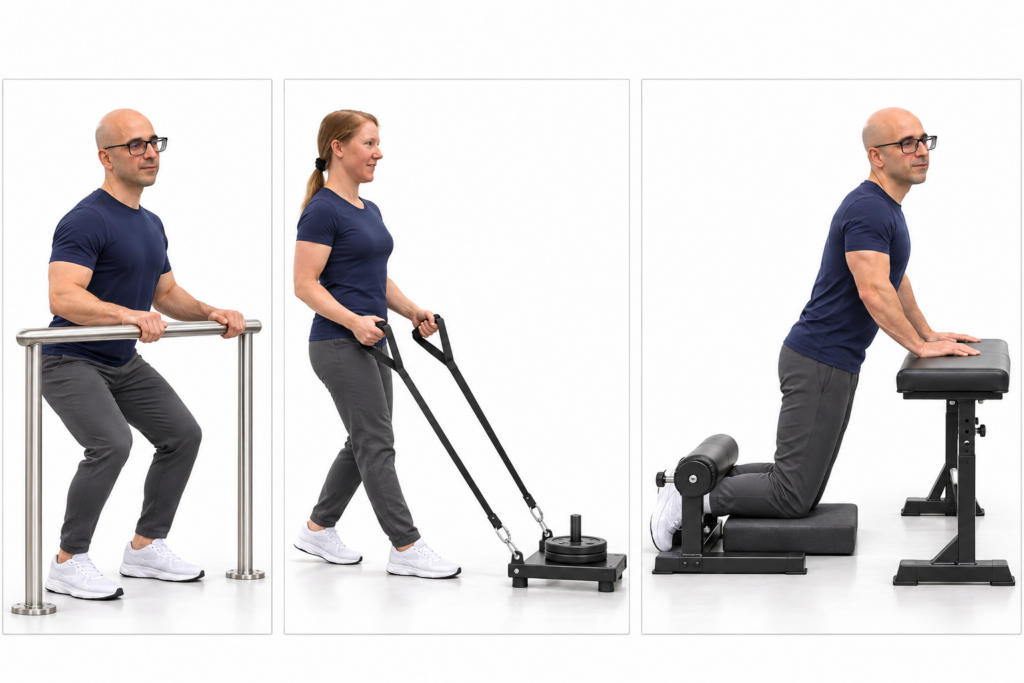
These are choices for a later, individualized plan. They are not a checklist to complete and should not all be added at once.
- Assisted squat: Hold a fixed support and sit back into a shallow, controlled squat with both heels down. A sit-to-stand from a higher chair is another starting option. Gradually increase comfortable depth, then reduce support, then add light load. Deep squatting is optional.
- Light backward sled: Once unresisted backward walking is comfortable, a clinician or coach can introduce light resistance on a clear, level surface. Use short controlled steps and short bouts. This is an optional progression; the starter exercise remains field or treadmill walking with no bar.
- Assisted Nordic: Consider only after comfortable hamstring curls, with suitable padding, secure ankle support and qualified instruction. Use substantial assistance and a small range first; increase demand gradually. Skip it if kneeling or the tendon load provokes symptoms.
When to get assessed
Get urgent assessment for a very swollen, deformed or locked knee, inability to bear weight, or a hot/red knee with fever or feeling unwell. Do not use this protocol to manage those symptoms. Persistent worsening, swelling or loss of function also needs reassessment. See the NHS guidance on knee-pain warning signs.
AI movement illustrations of Dr. Tro and Dr. Laura.
Get your free knee-pain worksheet
Illustrated exercises, starting doses, progression guidance and a fillable practice log.
What the evidence supports
Tailored exercise and education are supported for common knee-pain conditions. The 2024 patellofemoral-pain best-practice guide recommends knee-targeted exercise, with hip exercise where appropriate. NICE osteoarthritis guidance recommends strengthening and aerobic activity. Although some rehabilitation allows mild discomfort, this plan uses a conservative pain-free starting rule.
A 2019 trial of 68 people with knee osteoarthritis found benefit from adding backward walking to usual rehabilitation, without a significant advantage over forward walking. Evidence does not establish the named Patrick step, tibialis raise or ATG sequence as a superior knee-pain treatment. These movements are exercise options within an individualized plan.
The lower-leg, step, split-squat and later squat/hamstring options are informed by ATG’s public Knee Ability framework. This is a Toward Health clinical selection, not the complete branded ATG program. The AAOS knee-conditioning guide also includes calf raises, hamstring curls, hip work and stretching. The starting doses here are deliberately scaled for comfort.