
You finish a large holiday meal and feel completely full. Then someone brings out pie. Suddenly, you have room.
That experience is not imaginary, and it is not simply a failure of willpower. It reflects a well-described part of appetite called sensory-specific satiety: as you eat one food, the pleasure and desire associated with that food decline. A food with a different flavor, aroma, temperature, or texture can remain appealing—even when the first food no longer does.[1, 2, 3, 4, 5, 6]
This is one reason dessert can feel possible after dinner. You may be satiated with turkey, vegetables, or the main course while remaining responsive to something sweet, cold, creamy, crisp, or otherwise new.
This practical explanation grew from a July 2020 Toward Health group coaching discussion between Dr. Tro Kalayjian and health coach Amy Eiges. Their recurring message was to understand the mechanism and use that knowledge to build realistic replacements—not to demand perfection.

On this page
What sensory-specific satiety means
Sensory-specific satiety is the decline in the pleasantness of a particular food as it is eaten compared with foods that have not been eaten.[1, 2]
It is specific because the change is tied to the sensory qualities of that food. General hunger may have decreased, but a new taste or texture can still attract attention. The first bites of a food usually feel more rewarding than later bites, while an uneaten food can retain its appeal.
In foundational human experiments, the pleasantness of the eaten food fell more than the pleasantness of uneaten foods. Related work showed that serving a greater variety of foods within a meal increased intake.[1, 2] Sensory-specific satiety helps explain why a person can lose interest in one dish but continue eating when another arrives.
This response has a useful biological role. A varied natural food environment can encourage an organism to obtain a broader range of nutrients. The modern food environment can turn the same response toward prolonged eating by offering constant novelty: another flavor, another texture, another course, another condiment, or another snack.
Why variety can make us eat more
Restaurants, snack-food companies, supermarkets, and home cooks all understand the practical power of variety. Chip aisles expand from one flavor to dozens. Restaurant menus offer sweet, salty, crispy, creamy, hot, and cold options in one sitting. Holiday meals place many dishes on the table and bring dessert out after everyone says they are full.
Controlled research supports that familiar experience.
A 2021 systematic review identified 34 articles comprising 37 experimental studies of food variety. Its meta-analysis included 30 studies and 39 comparisons and found a significant small-to-medium overall effect: greater variety increased the amount of food or energy consumed.[11] That synthesis supports variety as a reproducible driver of intake rather than an isolated laboratory observation.
In a study of 21 adults, Brondel and colleagues served French fries followed by brownies under three conditions: without added variety, with condiments and toppings offered at the same time, or with new condiments and toppings introduced successively. Participants consumed more when the sensory experience changed. Average energy intake was about 1,195 calories in the monotonous condition, 1,485 calories when additions were offered simultaneously, and 1,682 calories when they were introduced successively.[3]
New sensory stimulation did more than add another food to the table. When ketchup was introduced after participants had eaten plain fries, the pleasantness of the fries increased again and they ate more. A similar response occurred when vanilla cream was added after plain brownies.[3]
The practical point is direct: variety can renew the desire to eat even after interest in the first version of a food has declined.
What happened when researchers reduced snack variety
Raynor, Niemeier, and Wing randomized 30 adults with overweight to two eight-week behavioral weight-loss programs. One group selected one snack food and limited its variety; the comparison group limited snack frequency without restricting variety.[7]
In the reduced-variety group, the chosen snack became less enjoyable over time, and its hedonic ratings declined more than ratings for other snack foods. Snack consumption also declined. Both groups lost weight, while the clearest effect of limiting variety was the development of long-term sensory-specific satiety and monotony toward the repeatedly selected snack.[7]
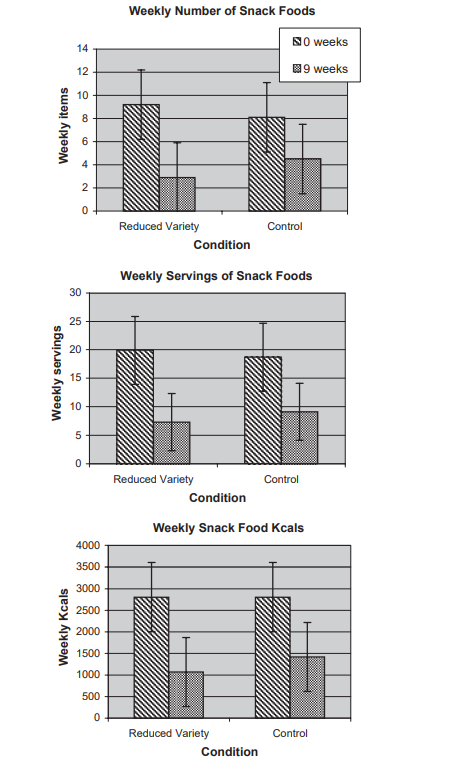
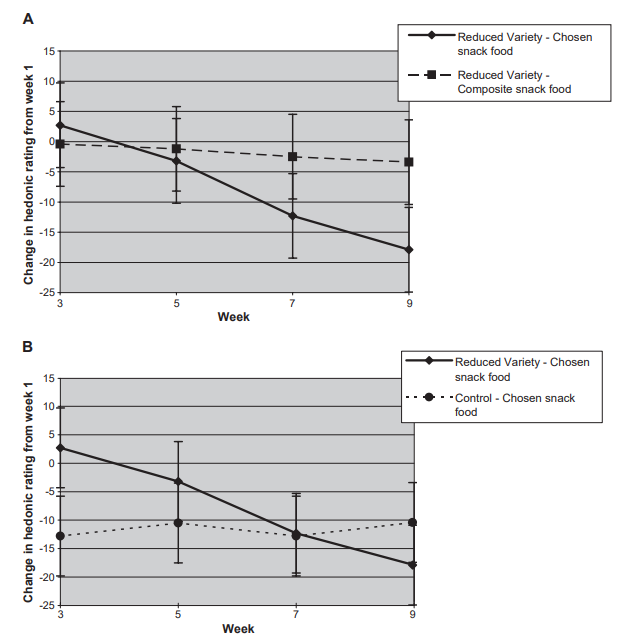
This does not mean every meal must be bland or nutritionally narrow. It means variety can be used strategically. Reducing the number of energy-dense trigger foods available at one time may decrease the number of sensory cues competing for another bite. Variety can also be directed toward foods a person wants to eat more often, such as protein-rich foods or lower-energy-density vegetables.
The effect is about sensory exposure—not simply calories
Sensory-specific satiety can develop quickly. It begins while a food is being eaten and is strongest soon afterward.[1, 6]
In a controlled study of 36 women, Bell, Roe, and Rolls compared milk-based foods that differed in volume and energy content. Doubling the volume while keeping energy constant produced a larger decline in pleasantness and greater sensory-specific satiety. Doubling energy without changing volume did not produce an additional effect.[5]
That finding helps separate sensory-specific satiety from a simple calorie counter. The sensations produced during eating, including taste, smell, texture, and volume, help determine when the appeal of a food fades.
Meillon and colleagues also found that after sensory-specific satiety had developed for a food, eating other foods during the meal did not restore the pleasantness of that original food.[4] The person can remain tired of one item while continuing to eat something different. That is precisely why a new course can remain attractive.
The modern food environment keeps offering a new signal
The problem is not variety itself. The problem is how easily variety can be concentrated into foods designed for repeated eating.
A single shopping trip can bring home multiple chips, desserts, snack bars, sweet drinks, sauces, and frozen foods. Each option creates another opportunity for novelty. Even if appetite fades for one flavor, another flavor may restart the eating process.
This can happen within one food category. A person may feel finished with a salty snack and then switch to something sweet. They may stop eating a crunchy food and continue with something creamy. The stomach did not suddenly become empty. The reward value changed because the sensory experience changed.
Newer controlled research shows how variety can work alongside another common feature of the food environment: large portions. In two randomized crossover experiments involving 42 and 49 women, high-variety meals increased intake whether the dishes were served simultaneously or sequentially. Larger portions independently increased intake, so variety and portion size added to one another rather than canceling each other out.[12]
The changing reward value is also visible in the brain. In a 2025 exploratory human fMRI study, repeated glucose exposure reduced liking for glucose while increasing the relative appeal of a neutral stimulus. Sensory-specific satiety was associated with activity in the lateral orbitofrontal and medial prefrontal cortices—regions involved in taste and reward-value processing. Individual differences in body weight and food-craving tendencies were also related to activation within this network.[13]
Food companies benefit when this pattern increases consumption. Understanding it gives the same information back to the person eating.
A useful lesson from raccoons exposed to human food waste
A raccoon study illustrates how a human-created food environment can affect other species.

Researchers compared adult raccoons from three sites with high, moderate, or low presumed access to anthropogenic food waste. Raccoons at the high-access site were heavier and had approximately twice the glycated serum protein concentration of raccoons at the lower-access sites. Glycated serum protein concentration is a marker of recent blood glucose exposure.[8]
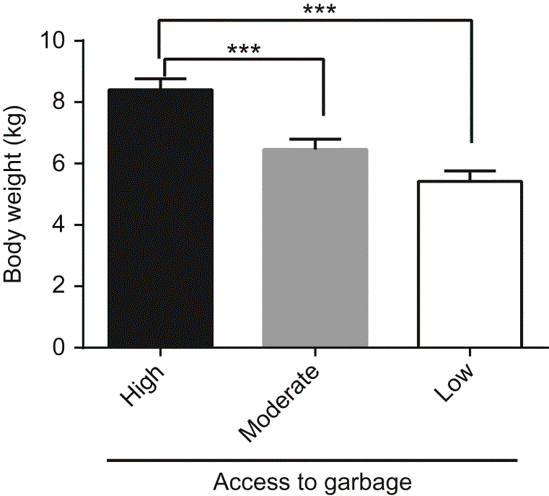
This was an observational animal study about access to human food waste, not a human trial of sensory-specific satiety. Its value here is environmental: when animals gain easier access to our food environment, measurable metabolic differences can follow.[8]
Use sensory-specific satiety to your advantage
The goal is not to remove all pleasure or variety from eating. It is to stop letting unplanned variety repeatedly override the stopping signals you already have.
1. Identify the sensory quality you are seeking
When a craving appears, ask what experience is driving it:
- Sweet
- Salty
- Crunchy
- Creamy
- Cold
- Warm
- Carbonated
- Chewy
- Comforting or familiar
Naming the desired experience makes it easier to choose a replacement that actually satisfies it.
2. Choose one satisfying replacement in advance
Replacement works better than a vague plan to resist.
If a person usually moves from dinner to brownies, a preselected alternative may be a small low-carbohydrate dessert, Greek yogurt prepared to fit the person’s nutrition plan, flavored seltzer, tea, or another option that addresses the desired taste profile. The best choice is the one that supports the person’s goals and does not reliably trigger continued eating.
A replacement does not have to be nutritionally perfect to be strategically useful. It needs to move the person away from the food or pattern that repeatedly causes difficulty.
3. Reduce simultaneous trigger-food options
The easiest moment to manage variety is before the food is on the table.
- Buy fewer flavors of foods that are difficult to stop eating.
- Avoid opening several snack choices at once.
- Serve one planned portion rather than displaying multiple packages.
- Decide on dessert before the meal instead of choosing among several options afterward.
- At restaurants, review the menu and decide on an order before hunger and novelty compete for attention.
The goal is to reduce biological pressure, not to stage a nightly test of self-control.
4. Keep meals satisfying
Limiting variety should not mean eating too little and remaining hungry. Build meals around adequate protein and minimally processed foods that fit the individual plan. A satisfying meal makes it easier to distinguish genuine hunger from renewed interest created by a different flavor or texture.
For some people, reducing sugar, refined starch, and highly processed foods makes hunger and cravings more predictable. A low-carbohydrate approach can also remove many combinations that repeatedly trigger eating. The practical question is not whether a food carries a particular label. It is whether the meal supports satiety and whether the available variety helps or undermines the person’s goal.
People using insulin, sulfonylureas, or other medications that can cause hypoglycemia should work with a clinician before substantially reducing carbohydrate because medication needs can change quickly.
5. Use variety where you want more intake
Variety is a tool. It can be reduced among energy-dense trigger foods and increased among foods a person wants to eat more often. In a randomized crossover study of 66 adults, offering three vegetables instead of one increased vegetable intake by an average of 48 grams without significantly changing the meal’s total energy intake.[9]
The same appetite principle can therefore be used in opposite directions depending on the goal.
The Toward Health coaching discussion also used restrictive eating disorders as an example of a setting in which greater food variety may support a different clinical goal. Research in weight-restored patients with anorexia nervosa found that greater dietary variety was associated with better outcomes during follow-up.[10] Nutritional rehabilitation for an eating disorder requires specialized medical, nutritional, and behavioral care; it is not a do-it-yourself application of this article.
6. Treat the “room for dessert” moment as information
When dessert suddenly sounds appealing after a filling meal, pause and name what is happening: I may be full, but this is a new sensory experience.
That moment of recognition creates space for a deliberate choice. The choice may be to have the planned dessert, use a replacement, save it for another time, or end the meal. The important change is understanding why the desire returned.
Watch: Sensory-Specific Satiety
Dr. Tro Kalayjian’s complete original 7-minute, 57-second video is included with this article.
Video: Sensory-Specific Satiety
The bottom line
Having room for dessert after a large meal does not mean the meal failed to fill you. Your appetite can be satiated for one set of flavors while remaining responsive to another.
Sensory-specific satiety explains why new tastes and textures can restart eating, why large menus and multiple snack flavors can increase intake, and why reducing unplanned variety can make eating feel easier.
Use that knowledge deliberately. Keep meals satisfying, limit the variety of foods that repeatedly pull you past fullness, and prepare replacements that match the sensory experience you actually want. The goal is not constant restraint. It is an environment that asks less of willpower.
References
- Rolls BJ, Rolls ET, Rowe EA, Sweeney K. Sensory specific satiety in man. Physiology & Behavior. 1981;27(1):137-142. doi: 10.1016/0031-9384(81)90310-3. ↩1↩2↩3↩4
- Rolls BJ, Rowe EA, Rolls ET, Kingston B, Megson A, Gunary R. Variety in a meal enhances food intake in man. Physiology & Behavior. 1981;26(2):215-221. doi: 10.1016/0031-9384(81)90014-7. ↩1↩2↩3
- Brondel L, Romer M, Van Wymelbeke V, et al. Variety enhances food intake in humans: role of sensory-specific satiety. Physiology & Behavior. 2009;97(1):44-51. doi: 10.1016/j.physbeh.2009.01.019. Study. ↩1↩2↩3
- Meillon S, Thomas A, Havermans R, Pénicaud L, Brondel L. Sensory-specific satiety for a food is unaffected by the ad libitum intake of other foods during a meal. Is SSS subject to dishabituation? Appetite. 2013;63:112-118. doi: 10.1016/j.appet.2012.12.004. Study. ↩1↩2
- Bell EA, Roe LS, Rolls BJ. Sensory-specific satiety is affected more by volume than by energy content of a liquid food. Physiology & Behavior. 2003;78(4-5):593-600. doi: 10.1016/S0031-9384(03)00055-6. Study. ↩1↩2
- Hetherington MM, Rolls BJ. The time course of sensory-specific satiety. Appetite. 1989;12(1):57-68. PubMed record. ↩1↩2
- Raynor HA, Niemeier HM, Wing RR. Effect of limiting snack food variety on long-term sensory-specific satiety and monotony during obesity treatment. Eating Behaviors. 2006;7(1):1-14. doi: 10.1016/j.eatbeh.2005.05.005. DOI. ↩1↩2
- Schulte-Hostedde AI, Mazal Z, Jardine CM, Gagnon J. Enhanced access to anthropogenic food waste is related to hyperglycemia in raccoons (Procyon lotor). Conservation Physiology. 2018;6(1):coy026. doi: 10.1093/conphys/coy026. ↩1↩2
- Meengs JS, Roe LS, Rolls BJ. Vegetable variety: an effective strategy to increase vegetable intake in adults. Journal of the Academy of Nutrition and Dietetics. 2012;112(8):1211-1215. doi: 10.1016/j.jand.2012.05.013. PubMed record. ↩
- Schebendach JE, Mayer LES, Devlin MJ, Attia E, Contento IR, Wolf RL, Walsh BT. Dietary energy density and diet variety as predictors of outcome in anorexia nervosa. The American Journal of Clinical Nutrition. 2008;87(4):810-816. doi: 10.1093/ajcn/87.4.810. PubMed record. ↩
- Embling R, Pink AE, Gatzemeier J, Price M, Lee MD, Wilkinson LL. Effect of food variety on intake of a meal: a systematic review and meta-analysis. The American Journal of Clinical Nutrition. 2021;113(3):716-741. doi: 10.1093/ajcn/nqaa352. PubMed record. ↩
- Cunningham PM, Roe LS, Keller KL, Rolls BJ. Variety and portion size combine to increase food intake at single-course and multi-course meals. Appetite. 2023;191:107089. doi: 10.1016/j.appet.2023.107089. PubMed record. ↩
- Simon JJ, Müller T, Schöner F, Bendszus M, Friederich HC. Savoring satiety: an exploratory analysis of the neural correlates of sensory-specific satiety. Nutrients. 2025;17(20):3229. doi: 10.3390/nu17203229. PubMed record. ↩
Existing internal links carried forward
Related links:
- Understanding Hunger: https://toward.health/understanding-hunger-why-your-hunger-has-nothing-to-do-with-willpower/
- Managing Cravings: https://toward.health/managing-cravings-the-moment-after-the-f-its-hit/
- How to Handle Food Pressure: https://toward.health/how-to-handle-food-pressure/
- Toward Health Coaching: https://toward.health/health-coaching/