
Train your whole body twice a week with a short, repeatable routine: ten exercises per day, one working set followed by one drop set for each weighted movement, then move on.
The plan at a glance
- Schedule: two nonconsecutive days, such as Monday and Thursday.
- Exercises: follow the ten-exercise list for that day.
- Effort: use full repetitions and controlled partials, stopping when you cannot complete 50% of the movement while maintaining form; reduce the weight once and repeat.
- Tempo: lift and lower slowly, keeping control throughout every repetition.
Warm up for five to 10 minutes and perform lighter practice sets before your first hard lower-body and upper-body exercises. Warm-up sets do not count as working sets.
If you are new to resistance training, learn the movements with lighter weights first. Match exercises to your ability, equipment and injuries; get individual guidance if pain, balance problems, recent surgery or a medical condition affects exercise safety.
One working set, one drop set
- Main set: perform full repetitions, then controlled partials. Stop when you cannot complete 50% of the movement while maintaining form.
- Drop the weight once: reduce the load by about 20–30% and repeat the same sequence immediately.
- Move on: after that single drop set, rest until you are ready to perform the next exercise with control.
Choose stable exercises that let you finish safely and reduce the load easily. For squats and hip hinges, stop when position or control changes; do not force partial reps.
Control is the limit: no bouncing, jerking or forced repetitions. End the set when position or control breaks down, or if you feel sharp or joint pain.
Your two weekly workouts
Day 1 — Full body
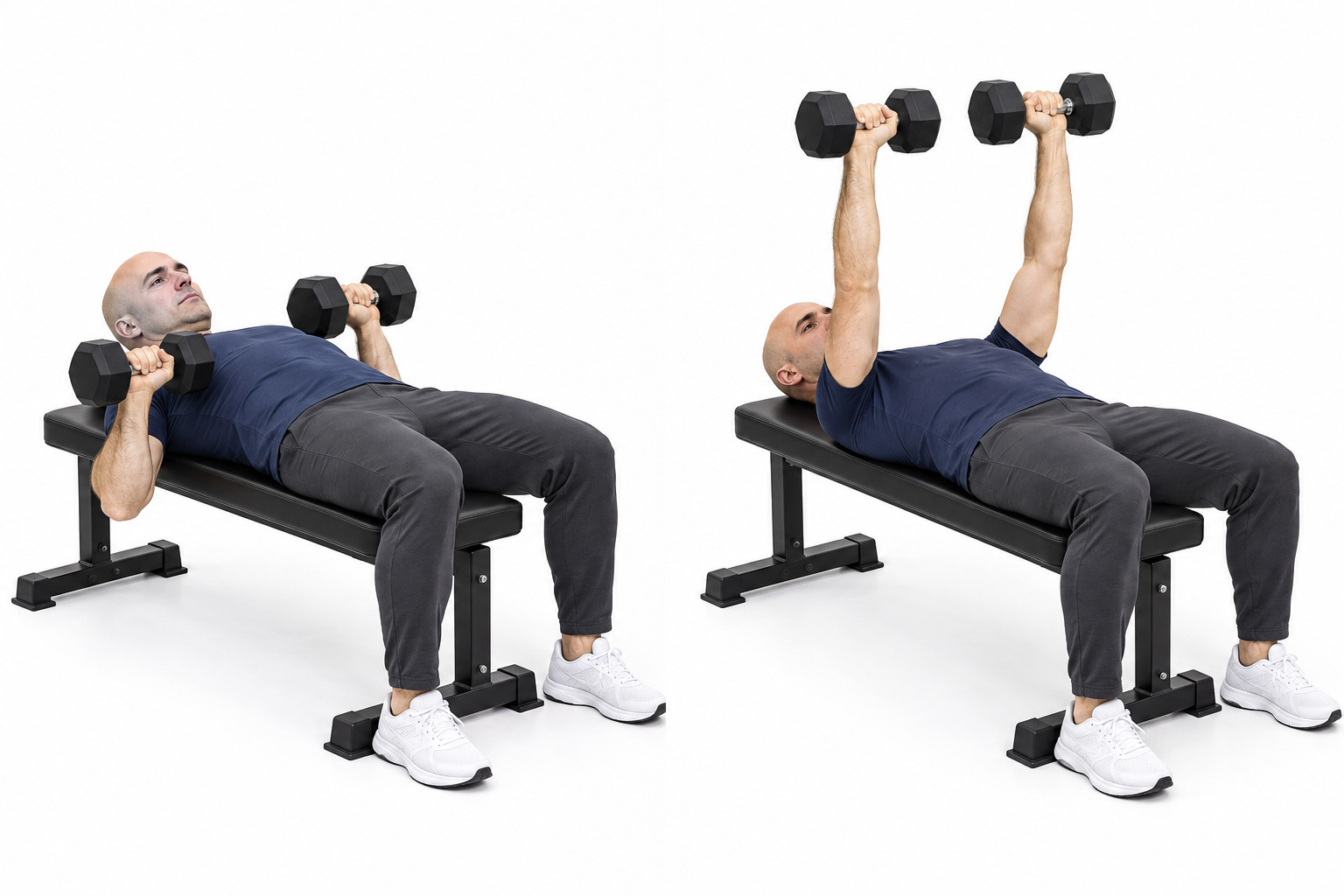
- ChestDumbbell bench press
- BackBench-supported dumbbell row
- ShouldersDumbbell lateral raise
- BicepsDumbbell curl
- TricepsBand pushdown
- QuadricepsGoblet squat
- HamstringsDumbbell Romanian deadlift
- GlutesDumbbell hip thrust
- CalvesStanding dumbbell calf raise
- CoreForearm plank
Day 2 — Full body
- ChestDumbbell chest fly
- BackBand lat pulldown
- ShouldersDumbbell shoulder press
- BicepsHammer curl
- TricepsOverhead dumbbell extension
- QuadricepsSeated ankle-weight knee extension
- HamstringsSupported ankle-weight hamstring curl
- GlutesBand glute kickback
- CalvesSeated dumbbell calf raise
- CoreDead bug
Dumbbell bench press
Dumbbell chest fly
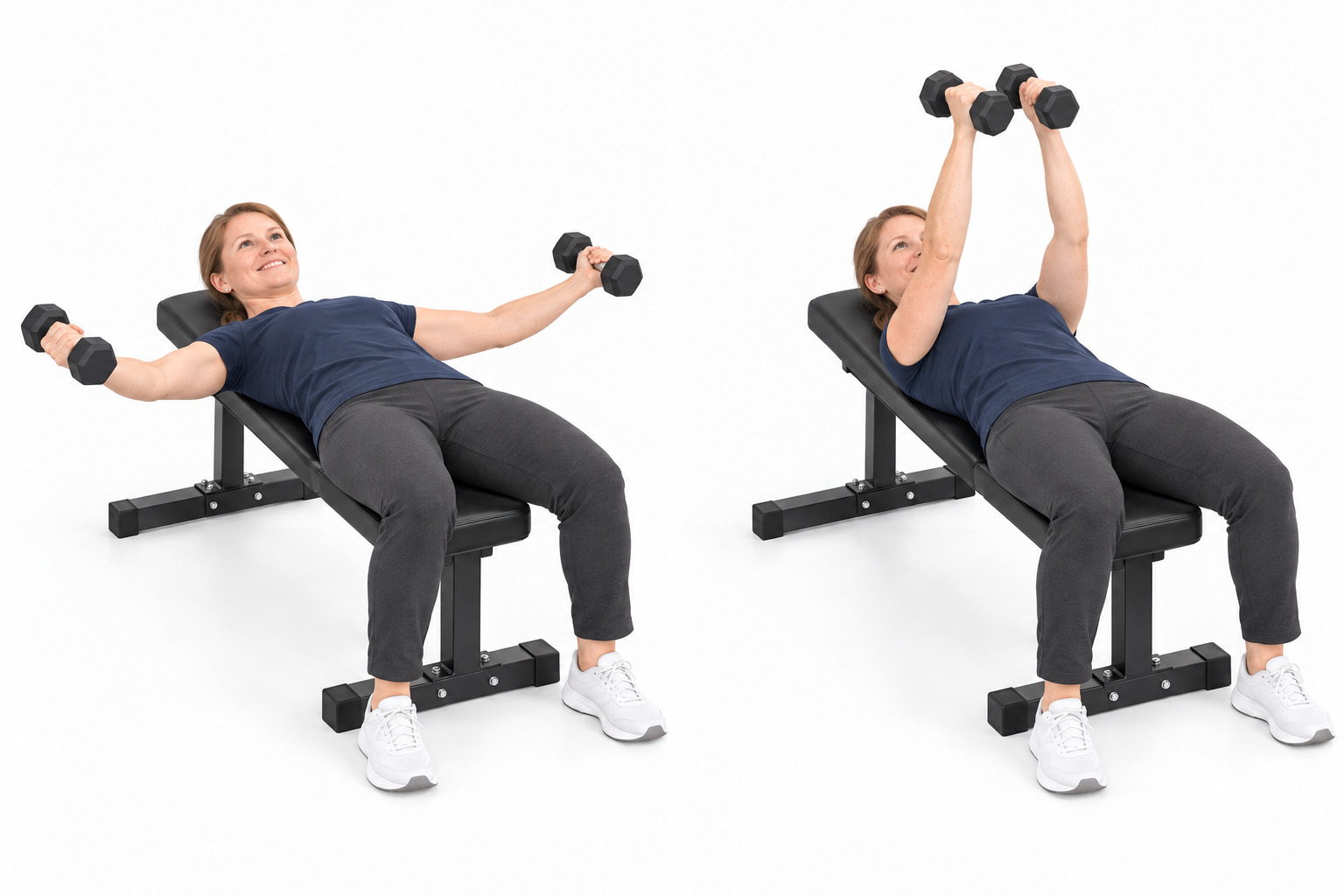
AI movement illustrations of Dr. Tro and Dr. Laura. All 20 movement demonstrations and weekly checkboxes are included in your worksheet.
Use a secure anchor for band exercises. To make the drop, use lighter dumbbells or ankle weights, a lighter band, or less band tension.
Core: for the forearm plank and dead bug, stop when you can no longer maintain position and control. These do not need a weight drop or partial reps.
Get your free Minimalist workout worksheet
Get the PDF and its weekly email series.
Weekly lessons arrive Saturdays at 10:00 a.m. Eastern, one series at a time.
How to progress
- Choose a starting weight you can lift through controlled full repetitions with good form.
- Record the starting weight and full repetitions, then the reduced weight and full repetitions. Record partials separately.
- When you can consistently perform more full repetitions with the same weight and control, increase the starting weight by the smallest practical amount.
If technique deteriorates or performance drops for several sessions, reduce the load or total work and reassess recovery.
Recovery
Leave at least one recovery day between strength sessions. Prioritize consistent sleep, adequate food and fluids, and enough recovery to repeat the next workout with control.
Sources
Research supports twice-weekly resistance training and shows that brief single-set routines and drop sets can be useful, time-efficient options. [1] [2] [4] [5] The sequence above is the method used in this plan, not a claim that every part is necessary or superior for everyone.
- Currier BS, D'Souza AC, Fiatarone Singh MA, et al. American College of Sports Medicine Position Stand. Resistance Training Prescription for Muscle Function, Hypertrophy, and Physical Performance in Healthy Adults: An Overview of Reviews. Medicine & Science in Sports & Exercise. 2026;58(4):851–872. PubMed · Full text · doi:10.1249/MSS.0000000000003897
- Currier BS, McLeod JC, Banfield L, et al. Resistance training prescription for muscle strength and hypertrophy in healthy adults: a systematic review and Bayesian network meta-analysis. British Journal of Sports Medicine. 2023;57(18):1211–1220. Full text · doi:10.1136/bjsports-2023-106807
- Robinson ZP, Pelland JC, Remmert JF, et al. Exploring the dose-response relationship between estimated resistance training proximity to failure, strength gain, and muscle hypertrophy: a series of meta-regressions. Sports Medicine. 2024;54(9):2209–2231. PubMed · doi:10.1007/s40279-024-02069-2
- Hermann T, Mohan AE, Enes A, et al. Without Fail: muscular adaptations in single-set resistance training performed to failure or with repetitions-in-reserve. Medicine & Science in Sports & Exercise. 2025;57(9):2021–2031. PubMed · doi:10.1249/MSS.0000000000003728
- Sødal LK, Kristiansen E, Larsen S, van den Tillaar R. Effects of drop sets on skeletal muscle hypertrophy: a systematic review and meta-analysis. Sports Medicine – Open. 2023;9:66. PubMed · Full text · doi:10.1186/s40798-023-00620-5
- Havers T, Micke F, Geisler S, Held S. Acute and chronic effects of drop-set training: a meta-analysis and systematic review. Sports Medicine – Open. 2026;12(1):38. PubMed · Full text · doi:10.1186/s40798-026-01012-1
- Jabekk PT, Moe IA, Meen HD, Tomten SE, Høstmark AT. Resistance training in overweight women on a ketogenic diet conserved lean body mass while reducing body fat. Nutrition & Metabolism. 2010;7:17. PubMed · Full text · doi:10.1186/1743-7075-7-17
- Valinejad A, Khodaei K. Does exercise during a ketogenic diet effectively alter appetite sensation, appetite-regulating hormones, and body composition? Experimental Biology and Medicine. 2022;247(21):1898–1906. PubMed · Full text · doi:10.1177/15353702221113862
Supplements
- Creatine monohydrate: 3–5 g daily is a well-supported option for strength and repeated high-intensity exercise.
- Electrolytes: consider replacing them during prolonged, hot or especially sweaty sessions. For shorter workouts, water and regular meals may be enough.
- Collagen: an optional consideration when tendon or connective-tissue training is a focus. Evidence is mixed, and it does not replace adequate complete protein.
- L-carnitine: an individualized option with inconsistent evidence for strength or exercise performance; it is not required for this plan.
If you have kidney or cardiovascular disease, take medication, or have fluid or sodium restrictions, review supplement choices with your care team. Sources: sleep, hydration, creatine, collagen, and L-carnitine.
Updated October 22, 2026: This recovery and supplement section was added after the article’s earlier medical review.
Discuss this exercise plan with your clinical team before starting. This is general education, not personalized medical or exercise advice.