
You can be eating well, following your plan, and feeling in control—and then life gets hard.
Work pressure rises. Someone you love becomes ill. Sleep falls apart. Conflict follows you home. You may still be choosing the same foods, yet you begin eating more often, reaching for more rewarding foods, or feeling hungry at times that do not make sense.
That is not imaginary, and it is not simply a failure of willpower. Stress changes both the body’s drive to eat and the brain’s ability to pause before acting on that drive.
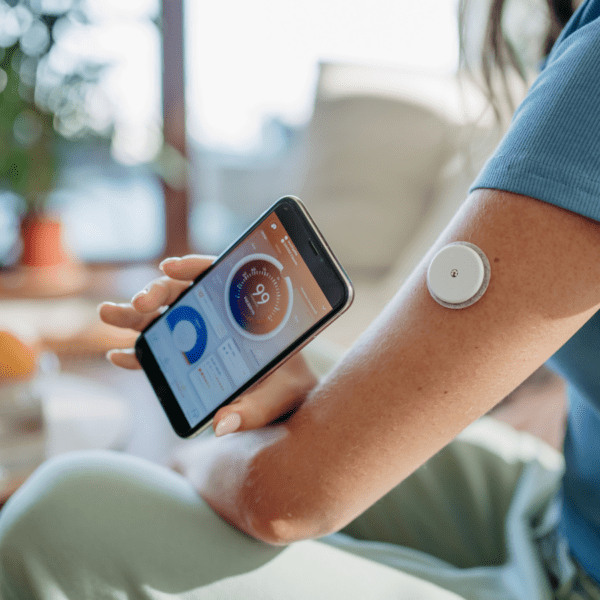
At Toward Health, remote weight and glucose monitoring has helped us recognize patterns that might otherwise remain invisible between office visits. In our practice, stress is one of the most common patterns we see before weight regain. The change may be dramatic, but it is often quiet: a little more food after dinner, more frequent eating, fewer planned meals, less sleep, and more exposure to foods designed to be difficult to stop eating.
The goal is not to pretend stress can be eliminated. The goal is to understand what it does, recognize the vulnerable window, and have a replacement plan ready before the urge arrives.
On this page
Stress makes energy available—even when you have not eaten
The acute stress response is designed for survival. Adrenaline, noradrenaline, glucagon, cortisol, and other signals help mobilize stored energy so the body can respond to a perceived threat. These same signals can temporarily change glucose regulation and insulin sensitivity.
During the stressful event itself, you may not feel hungry at all. If you were being chased by a wolf, eating would not be the priority.
The vulnerable period often comes later: after the meeting ends, after the children are asleep, after you get home, or when you finally sit down. The threat has passed, but the stress response, fatigue, food cues, and learned coping patterns are still present. That is when the urge for fast, highly rewarding food can feel unusually strong.
Stress can increase food reward before you recognize hunger
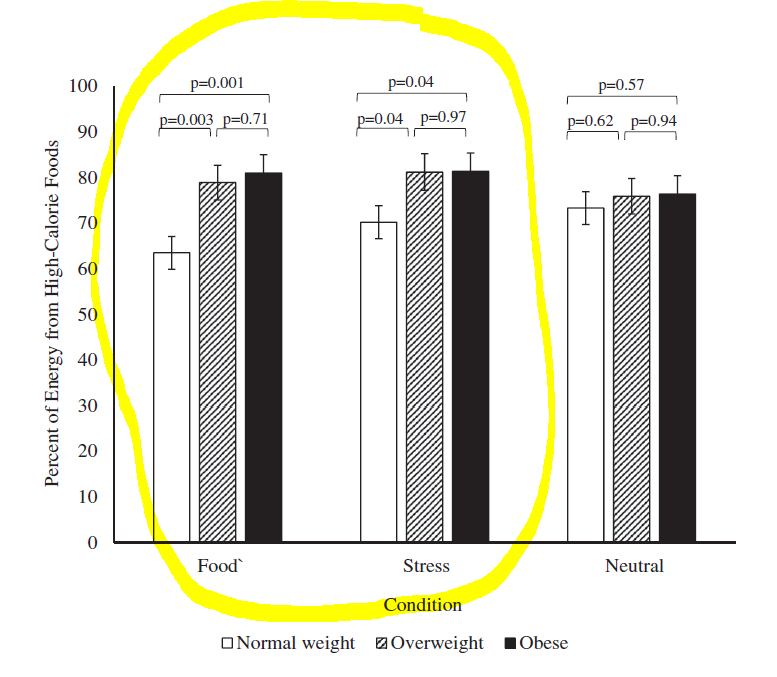
The research includes a controlled laboratory study by Chao and colleagues involving 138 participants. Each participant completed stress, food-cue, and neutral imagery sessions on separate days before receiving access to high- and low-calorie snack foods.[1]
The study did not show that stress made everyone eat more total calories. It showed something more specific: after the stress cue, participants with obesity obtained 81.4% of their snack calories from high-calorie foods, compared with 70.2% among participants with normal weight. Stress changed the kind of food selected even when self-reported hunger did not fully explain the behavior.[1]
Hunger ratings in the same laboratory study
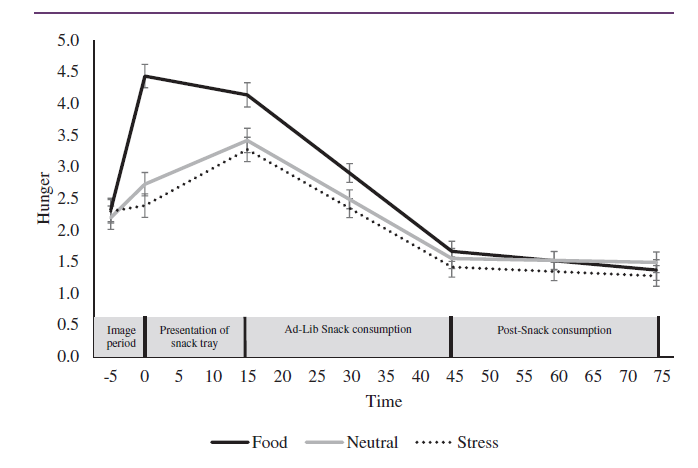
Other laboratory studies have found similar patterns. Stress exposure has been associated with stronger craving for highly palatable foods, greater intake of those foods in participants with overweight or obesity, and changes in cortisol and ghrelin that track with craving and intake.[2] Brain-imaging research has also found that stress and favorite-food cues activate reward and motivation circuits more strongly in people with obesity, with responses related to insulin levels and insulin resistance.[3]
This helps explain a familiar experience: you may not think, “I am physically hungry,” but you still find yourself searching the kitchen.
Stress makes the most rewarding option feel more compelling
Stress does not create a craving for every food equally. It tends to increase the appeal of foods that deliver a rapid, intense reward—often combinations of refined carbohydrate, fat, salt, and flavor.
In a study of 30 women, higher chronic stress was associated with stronger activation in brain regions involved in reward, motivation, and habitual decision-making when participants viewed high-calorie food images. Higher stress was also associated with reduced activity in frontal regions involved in planning and emotional control, as well as greater intake of high-calorie foods from a snack buffet.[4]
Another human imaging study found that a month of psychosocial stress disrupted prefrontal attentional control and frontoparietal connectivity. Those changes were reversible after a month of reduced stress.[5]
The practical meaning is important: stress can strengthen the urge while weakening the pause. Calling that a “willpower problem” misses the biology and offers no useful plan.
Chronic stress can become weight regain through small repeated changes
Stress-related weight regain does not require an obvious binge or complete abandonment of a dietary plan. It can develop through smaller changes repeated over time:
- eating more frequently;
- eating after a meal despite being physically full;
- choosing more rewarding foods;
- eating directly from a package;
- using food to mark the end of a hard day;
- sleeping less and moving less;
- fasting less often or losing the usual meal structure.
In a prospective study of 339 adults, higher chronic stress, cortisol, and insulin at baseline each predicted greater weight gain over the following six months.[6] The study does not mean every stressed person will gain weight. It does show that the connection can extend beyond a single difficult meal.
That is why a stressful season may call for a different goal. In our practice, we often stop pushing for active weight loss during an acute crisis and focus first on satiety, structure, support, and preventing regain. Maintenance during a hard period is a meaningful clinical success.
Build a replacement plan before you need it
A memorable way to approach this is the good, better, best strategy. The point is not perfection. The point is to put distance between the stress cue and the most harmful automatic response.
Good: choose a planned low-carb replacement
Keep an option available that gives you the feeling of having something without reopening the full cycle of high-reward eating. Portion it onto a plate instead of eating from the package. A replacement is a defensive tool, not a moral compromise.
Better: eat a real, satisfying meal
Use leftovers or prepare a simple meal centered on protein and minimally processed food. Meat, fish, poultry, eggs, and other protein-rich foods can be paired with non-starchy vegetables or another low-carbohydrate food that works for you.
If you are genuinely hungry, a meal is usually more useful than a chain of snacks.
Best: change the state or the environment when you are not physically hungry
Water, seltzer, tea, a short walk, a shower, a phone call, prayer, breathing practice, or simply leaving the kitchen can interrupt the learned sequence. Coffee may work earlier in the day, but protecting sleep matters more than using caffeine late at night.
“Best” does not mean white-knuckling hunger. If you are physically hungry, eat. This option is for the moment when the need is relief, reward, or escape rather than food.
A five-step plan for the next stressful evening
- Name the state. Say, “I am stressed and vulnerable to automatic eating.” That is more useful than arguing with yourself.
- Check for physical hunger. If you would eat a real meal, choose the meal. If only a specific reward food sounds good, pause before acting.
- Use your good, better, best list. Decide the options in advance and keep the “better” choice easy to reach.
- Protect the next hour. Leave the kitchen, remove the cue, contact support, or begin a calming routine.
- Return to your normal structure at the next meal. Do not turn one difficult evening into days of restriction, guilt, or all-or-nothing thinking.
Structured approaches can help. In a randomized trial of 76 adults with overweight or obesity, adding a seven-week mindful-eating program to usual care reduced emotional eating at the end of treatment and at 12 months compared with usual care alone.[7] The weight difference was not significant, but the eating behavior changed—the outcome the program was designed to target.[7]
The lesson is not that everyone needs the same technique. It is that stress eating is a behavior that can be anticipated, practiced, and changed.
Stress deserves support, not shame
Food can become a powerful coping tool because it works quickly. That does not make you weak. It means the replacement has to meet the real need: relief, comfort, a transition out of work, connection, rest, or help.
Daily movement, sleep routines, mental health care, social support, and a prepared food environment all make the stressful moment easier to navigate. If eating feels out of control, causes marked distress, or includes recurrent binge episodes, talk with a qualified clinician. Depression, anxiety, trauma, and persistent sleep problems also deserve direct treatment rather than being reduced to a diet problem.
Stress may increase hunger, make rewarding food more compelling, and reduce executive control. But those changes are not permanent. The right response is not more shame or a harsher plan. It is earlier recognition, stronger defenses, and support while the stress is still happening.
Related video: How Stress Makes You More Hungry — Watch the recording.
References
- Chao AM, Fogelman N, Hart R, Grilo CM, Sinha R. A laboratory-based study of the priming effects of food cues and stress on hunger and food intake in individuals with obesity. Obesity (Silver Spring). 2020;28(11):2090-2097. doi: 10.1002/oby.22952. ↩1↩2
- Sinha R, Gu P, Hart R, Guarnaccia JB. Food craving, cortisol and ghrelin responses in modeling highly palatable snack intake in the laboratory. Physiology & Behavior. 2019;208:112563. doi: 10.1016/j.physbeh.2019.112563. ↩
- Jastreboff AM, Sinha R, Lacadie C, Small DM, Sherwin RS, Potenza MN. Neural correlates of stress- and food cue-induced food craving in obesity: association with insulin levels. Diabetes Care. 2013;36(2):394-402. doi: 10.2337/dc12-1112. ↩
- Tryon MS, Carter CS, DeCant R, Laugero KD. Chronic stress exposure may affect the brain’s response to high calorie food cues and predispose to obesogenic eating habits. Physiology & Behavior. 2013;120:233-242. doi: 10.1016/j.physbeh.2013.08.010. ↩
- Liston C, McEwen BS, Casey BJ. Psychosocial stress reversibly disrupts prefrontal processing and attentional control. Proceedings of the National Academy of Sciences. 2009;106(3):912-917. doi: 10.1073/pnas.0807041106. ↩
- Chao AM, Jastreboff AM, White MA, Grilo CM, Sinha R. Stress, cortisol, and other appetite-related hormones: prospective prediction of 6-month changes in food cravings and weight. Obesity (Silver Spring). 2017;25(4):713-720. doi: 10.1002/oby.21790. ↩
- Morillo-Sarto H, López-Del-Hoyo Y, Pérez-Aranda A, et al. “Mindful eating” for reducing emotional eating in patients with overweight or obesity in primary care settings: a randomized controlled trial. European Eating Disorders Review. 2023;31(2):303-319. doi: 10.1002/erv.2958. ↩1↩2