
TOWARD HEALTH Announces 120-Patient Study Showing Sustained Weight Loss and Major Improvements in AHA PREVENT-Estimated Cardiovascular Risk
One year of TOWARD Health’s physician-led continuous-care intervention reduced estimated 10-year ASCVD risk by 29% and total cardiovascular risk by 28%, despite deliberately departing from conventional AHA dietary guidance on saturated fat, grains and other carbohydrate-rich foods. TOWARD Health recommends settling the science with a randomized trial of keto versus “heart healthy” AHA guidance.
BLAUVELT, N.Y. — TOWARD HEALTH today announced results from a 120-patient study examining one year of its continuous metabolic care intervention in adults with overweight or obesity.
The study used PREVENT, the American Heart Association’s contemporary cardiovascular risk framework. PREVENT integrates cardiovascular, metabolic and kidney health to estimate 10- and 30-year risk of cardiovascular disease, ASCVD and heart failure. The AHA now recommends PREVENT for primary-prevention risk assessment, including in its 2026 dyslipidemia guideline.
TOWARD Health agreed with the AHA on the importance of measuring the whole cardiovascular risk picture.
We did not agree with its diet.
The AHA continues to recommend limiting saturated fat to less than 6% of calories while emphasizing fruits, whole grains and legumes. Federal dietary guidance retains a 10% saturated-fat cap and recommends routine inclusion of whole grains.
After reviewing the evidence, TOWARD Health concluded that the evidence did not justify requiring those dietary restrictions in its medically supervised metabolic program.
We took the AHA’s scorecard and used it to grade a very different approach: real-food ketogenic nutrition and technology-enabled continuous metabolic care.
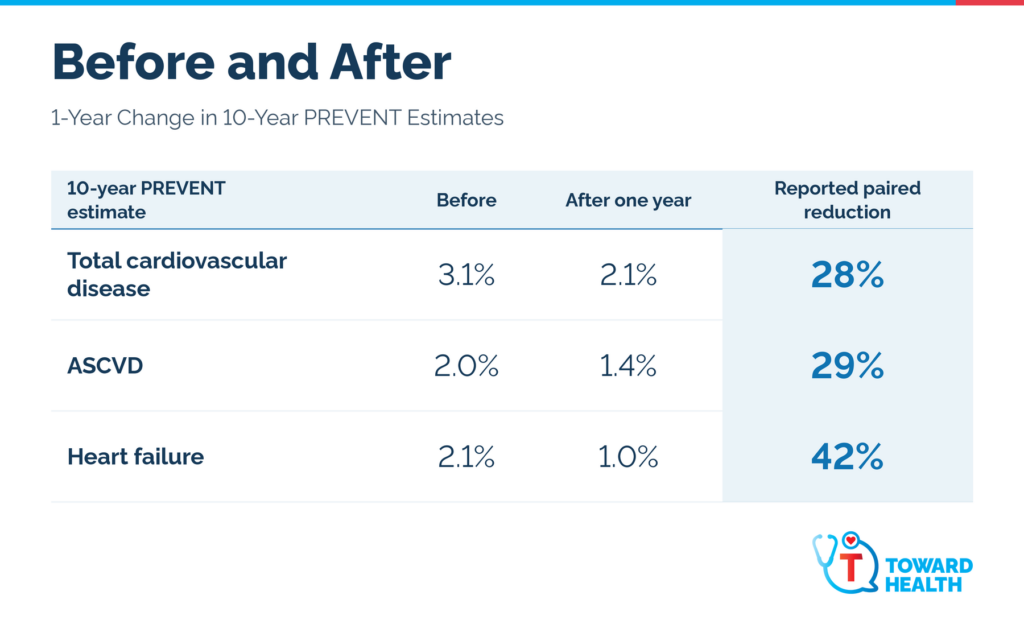
After one year, estimated 10-year:
- ASCVD risk fell 29%
- Total cardiovascular disease risk fell 28%
- Heart-failure risk fell 42%
The cohort also achieved 12.2% median weight loss, a 10.7 mmHg reduction in systolic blood pressure, a 0.48 percentage-point reduction in HbA1c, and a 34 mg/dL reduction in triglycerides, while stopping 125 medications. Weight decreased in 89 of the 90 participants included in the primary paired analysis.
What Is the TOWARD Health Intervention?
The TOWARD Health intervention is a physician-led continuous-care model combining health coaching, remote monitoring, ongoing messaging, frequent clinical feedback, AI-assisted technology and TOWARD Health’s proprietary patient app to support care between traditional medical visits.
Its dietary foundation is a real-food, low-carbohydrate approach. Patients substantially limit grains, beans, starches and fruit while emphasizing animal proteins and fats, non-starchy vegetables and whole foods, limiting seed oils, and without a prescribed saturated-fat cap.
The objective is not adherence to a diet label. It is improvement in metabolic health with ongoing clinical monitoring and treatment adjustment.
How Large Was the Cardiovascular Risk Improvement?
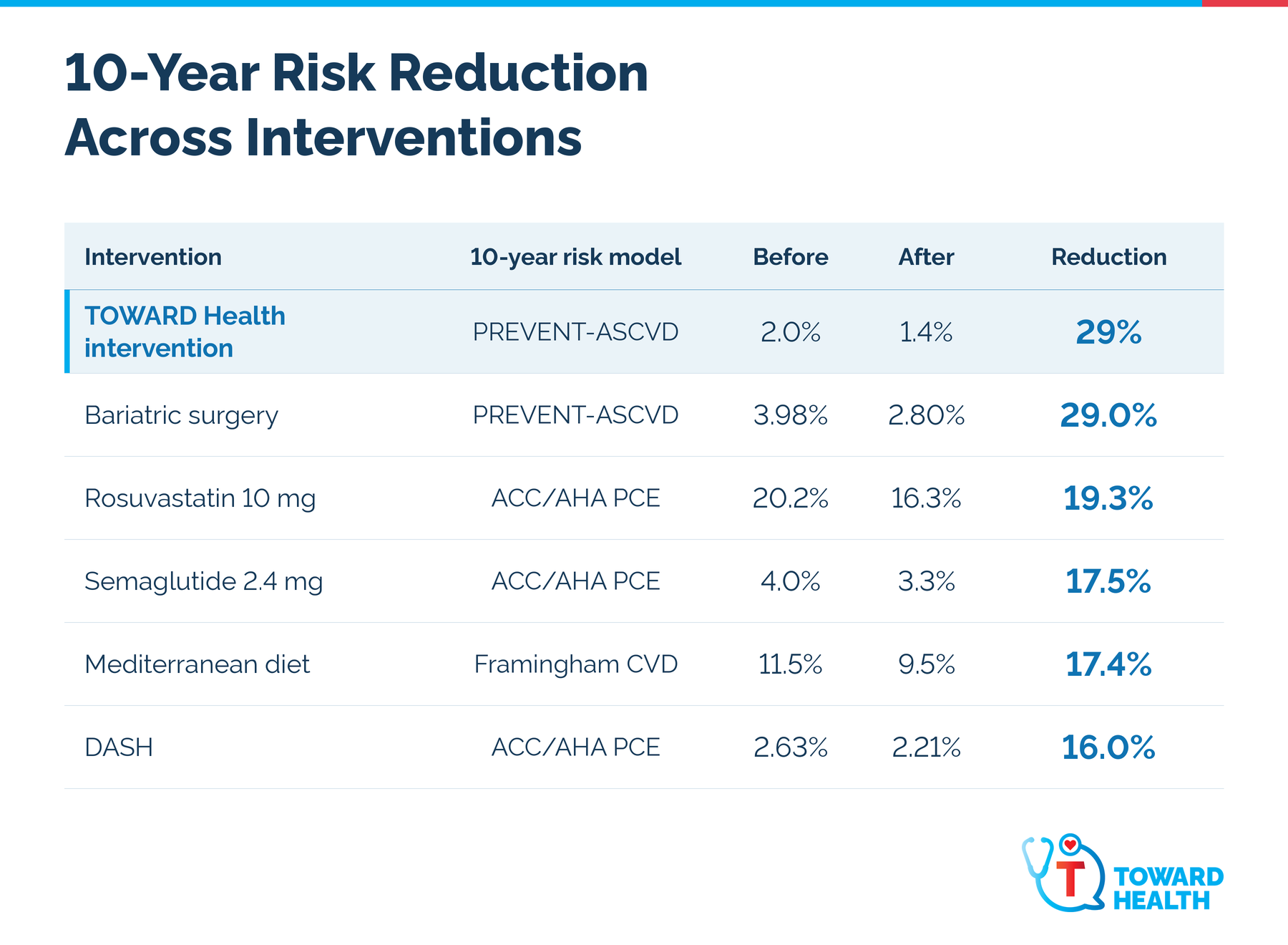
The closest published comparison using the same PREVENT-ASCVD framework is bariatric surgery.
In a Journal of the American Heart Association study, estimated 10-year ASCVD risk fell from 3.98% before bariatric surgery to 2.80% one year later, a 29.03% relative reduction.
TOWARD’s reported reduction was 29%.
Other commonly used dietary and medical interventions have also published before-and-after changes in established 10-year cardiovascular risk calculators:
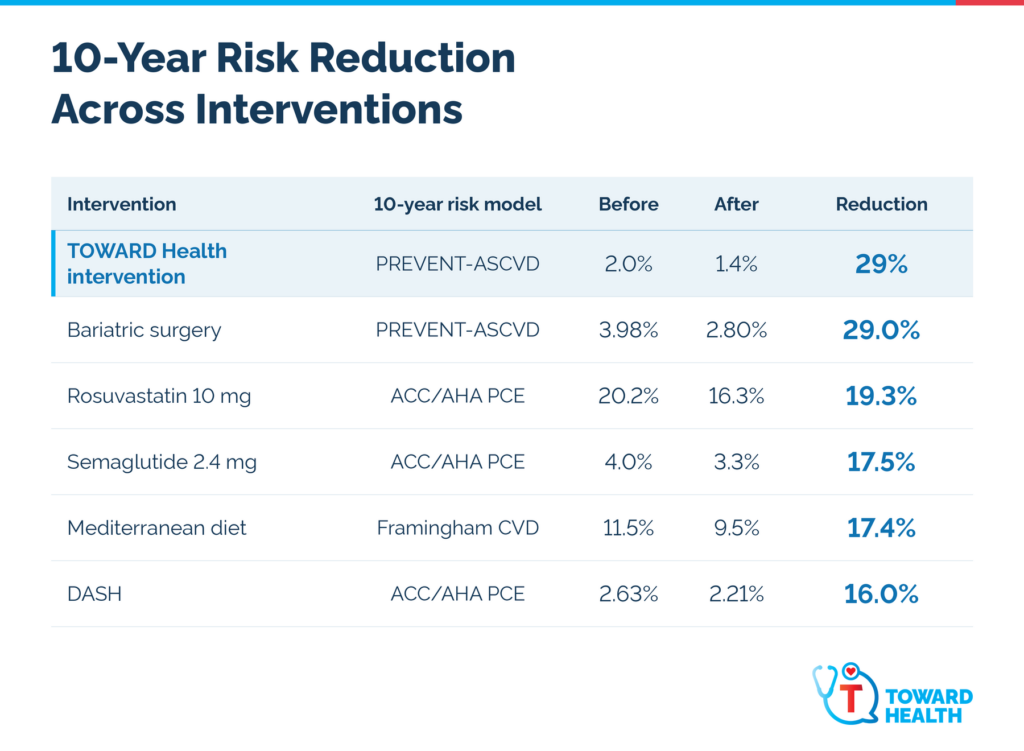
*These are not head-to-head comparisons.
“These findings do not prove that TOWARD is superior to surgery, medication or another dietary intervention,” said Tro Kalayjian, D.O., Chief Medical Officer of TOWARD Health. “But the magnitude of the change is impossible to dismiss. The AHA asked clinicians to evaluate cardiovascular risk comprehensively. We did exactly that. We simply did not follow their dietary prescription.”
The Results Challenge More Than a Saturated-Fat Recommendation
The disagreement is broader than saturated fat.
Conventional cardiovascular dietary guidance has continued to emphasize whole grains, legumes, fruits and replacement of animal fats with seed oils. TOWARD Health’s clinical model disregards those recommendations.
Yet when TOWARD evaluated its outcomes with the AHA’s own modern cardiovascular risk framework, estimated risk moved substantially in the favorable direction.
This raises a fundamental question:
Should we continue prioritizing low-fat, DASH, or Mediterranean dietary prescriptions and broad restrictions on animal foods and saturated fat, or should we recognize that real-food ketogenic approaches may provide an equally, or potentially more, effective path to improving metabolic and cardiovascular health?
TOWARD Health Is Calling for a Head-To-Head Trial
TOWARD Health has proposed a randomized clinical trial to CMS and is working with the MAHA Center to advance a direct comparison between two competing dietary approaches:
Real-food metabolic care that is low in carbohydrates (ketogenic) and no prescribed saturated-fat cap that otherwise aligns with the new DGA
versus
A conventional AHA and old DGA-aligned dietary approach emphasizing grains, legumes, fruit and seed oils.
The proposed research would compare changes in weight, glycemic control, diabetes remission, blood pressure, lipids, medication burden, quality of life, healthcare costs, cardiovascular risk and longer-term clinical outcomes.
“We are not asking HHS or the AHA to accept our conclusions on faith,” Kalayjian said. “We are asking them to help test them. If saturated-fat caps and routine grain inclusion produce better outcomes, a rigorous randomized trial should demonstrate it. If they do not, those recommendations should change.”
The current study was retrospective and did not include a randomized control group. It therefore cannot establish that the TOWARD intervention caused the observed changes or that reductions in estimated cardiovascular risk translate directly into reductions in cardiovascular events. Those limitations are exactly why the next step should be a randomized trial.
TOWARD Health reviewed the evidence, implemented an alternative model of metabolic care, measured the results and published them. The data are now strong enough to justify putting the competing dietary models head-to-head.
Read the Study
One-year change in PREVENT-estimated cardiovascular risk in a telehealth ketogenic diet cohort of adults with overweight or obesity
https://doi.org/10.1016/j.ajpc.2026.102087
About TOWARD Health
TOWARD Health is a physician-led metabolic health practice delivering continuous care for obesity, diabetes and related cardiometabolic disease through medical care, health coaching, remote monitoring, a proprietary patient app and AI-assisted technology.