
What does fasting research tell us about meal timing, weight and muscle? The studies below help explain why our practice values flexibility as well as the eating window itself.
There are many important benefits to fasting including weight loss, improved insulin sensitivity and blood-glucose control, as well as many others. However, it is important to understand that excessive reduction in total energy intake can result in some adverse events. For this reason it is important to discuss fasting with your doctor, especially if you are on glucose or blood pressure lowering medications. Our overall opinion is that learning to incorporate intermittent fasting is critical for many healthy lifestyle plans. In this article we will outline some of the important literature.
With regards to our program, we generally reinforce with our patients the concept that fasting is truly an expression of non-hunger. This means that fasting is literally just exercising the state of not being hungry and not being triggered to eat. More often than not, we find that a restrictive, regimented approach to fasting can often lead to feeling unsuccessful. When starting a fasting protocol, you will hear our coaches recommend simply delaying your first meal by utilizing some extra water, coffee, tea or seltzer and to proceed comfortably and particularly in a safe environment. Experimenting with intermittent fasting while heading into a business meeting where you will face pizza and muffins may not be a great plan. Instead, if you start slowly and safely, you will find that as you get comfortable delaying meals, fasting will become easier and easier over time. Often, our patients initially cannot imagine the idea of eating one meal in a day. However, by the end of our program, they usually find that the OMAD approach is easily attainable once their appetite is managed.
Early and later eating windows
As we explore the literature it's important to note that what happens during clinical trials is not always a pragmatic option for people in terms of a long-term sustainable lifestyle approach. For example, in the literature it is clear that late-night eating, and late time-restricted eating, are sub-optimal when compared to early time-restricted eating.
The Leung review below compares glucose and insulin responses to identical meals eaten during the day and at night. It found lower post-meal responses during the day. This supports the discussion of meal timing; it is not a trial of weight loss from a particular fasting schedule.
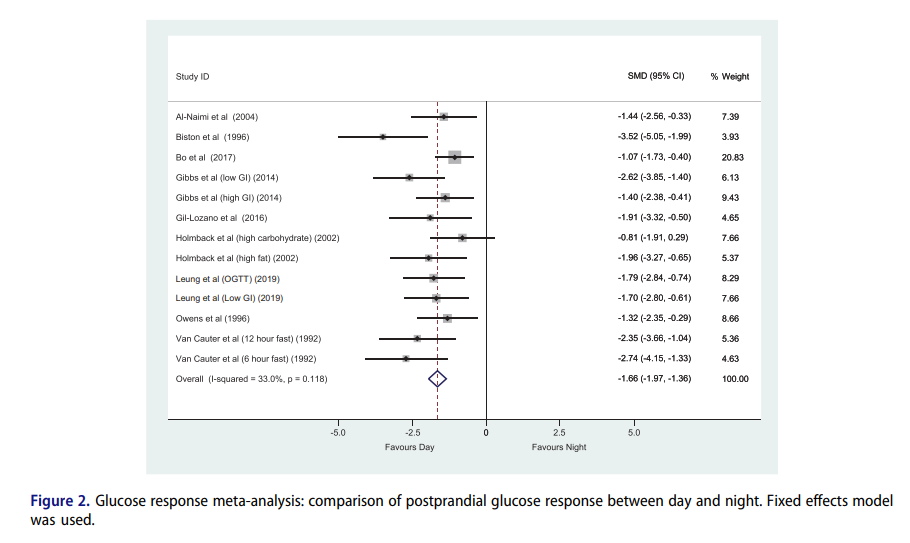
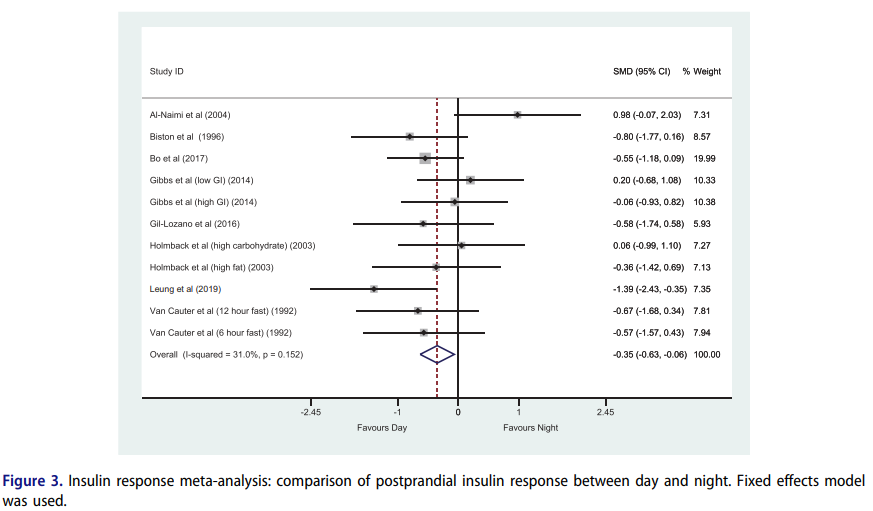
- Leung GKW, Huggins CE, Ware RS, Bonham MP. Time of day difference in postprandial glucose and insulin responses: Systematic review and meta-analysis of acute postprandial studies. Chronobiol Int. 2020 Mar;37(3):311-326. doi: 10.1080/07420528.2019.1683856
While on paper this early approach seems to have a slight benefit, in our practice the overwhelming opinion is to pick an eating window that works BEST for you. Skipping breakfast and enjoying dinner with our families is often easier and overall, SOME time restriction is better than none.
Bottom line: Overall, the most deleterious effects from late-night eating comes from the effects it has on reflux and poor sleep quality. The ideal eating window is an early eating window, say from 8am to 2pm. HOWEVER, we prefer the easiest window for you. Having said that, the majority of our patients proceed with a later eating window, say from 12 to 6pm, AND this is completely fine!
How long should the eating window be?
Another common question regarding fasting is "how many hours should I fast?" We have seen very clearly that there is not a large difference in effect when comparing a 4 hour window to a 6 hour window. In this study, it was shown that overall weight and energy intake was similar between groups.
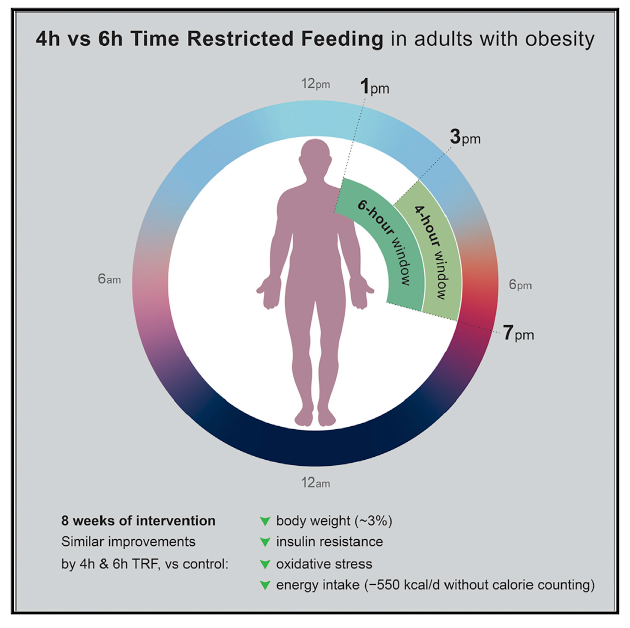
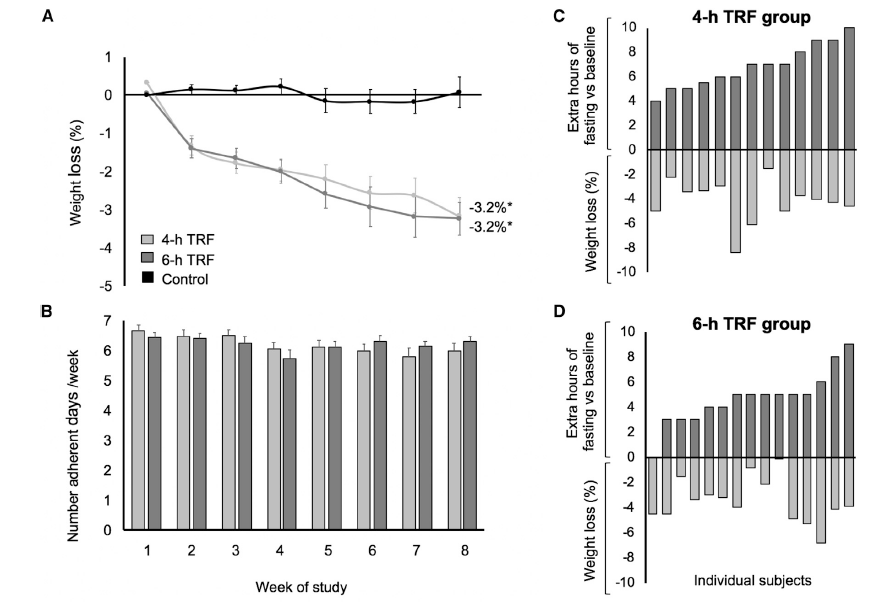
- Cienfuegos S, Gabel K, Kalam F, Ezpeleta M, Wiseman E, Pavlou V, Lin S, Oliveira ML, Varady KA. Effects of 4- and 6-h Time-Restricted Feeding on Weight and Cardiometabolic Health: A Randomized Controlled Trial in Adults with Obesity. Cell Metab. 2020 Sep 1;32(3):366-378.e3. doi: 10.1016/j.cmet.2020.06.018.
Studies have also examined one meal a day, or OMAD, and its effects on body weight. Our practice likes to use a flexible OMAD approach; ideally one where hunger is managed so well that one could easily eat one-meal, but also have the flexibility to eat 2MAD if their hunger is increased or they have social scenarios that make fasting difficult. We believe building this flexibility into fasting is critical to make it successful long term.
Fasting, muscle and exercise
Some doctors have cautioned that OMAD could lead to a decrease in muscle mass. This comes from a study that showed that daily time-restriction could lower lean-mass versus continuous-eating. While in the setting of the modern, standard diet, there may be some truth to this, other data paints a different picture.
- Lowe DA, Wu N, Rohdin-Bibby L, Moore AH, Kelly N, Liu YE, Philip E, Vittinghoff E, Heymsfield SB, Olgin JE, Shepherd JA, Weiss EJ. Effects of Time-Restricted Eating on Weight Loss and Other Metabolic Parameters in Women and Men With Overweight and Obesity: The TREAT Randomized Clinical Trial. JAMA Intern Med. 2020 Nov 1;180(11):1491-1499. doi: 10.1001/jamainternmed.2020.4153
In the Meessen study, lean participants completed an 11-day one-meal-a-day period and an 11-day three-meal period in a randomized crossover design. Planned energy intake was kept consistent. Lean mass and exercise performance were not reduced during this short study.
Physical activity and performance table
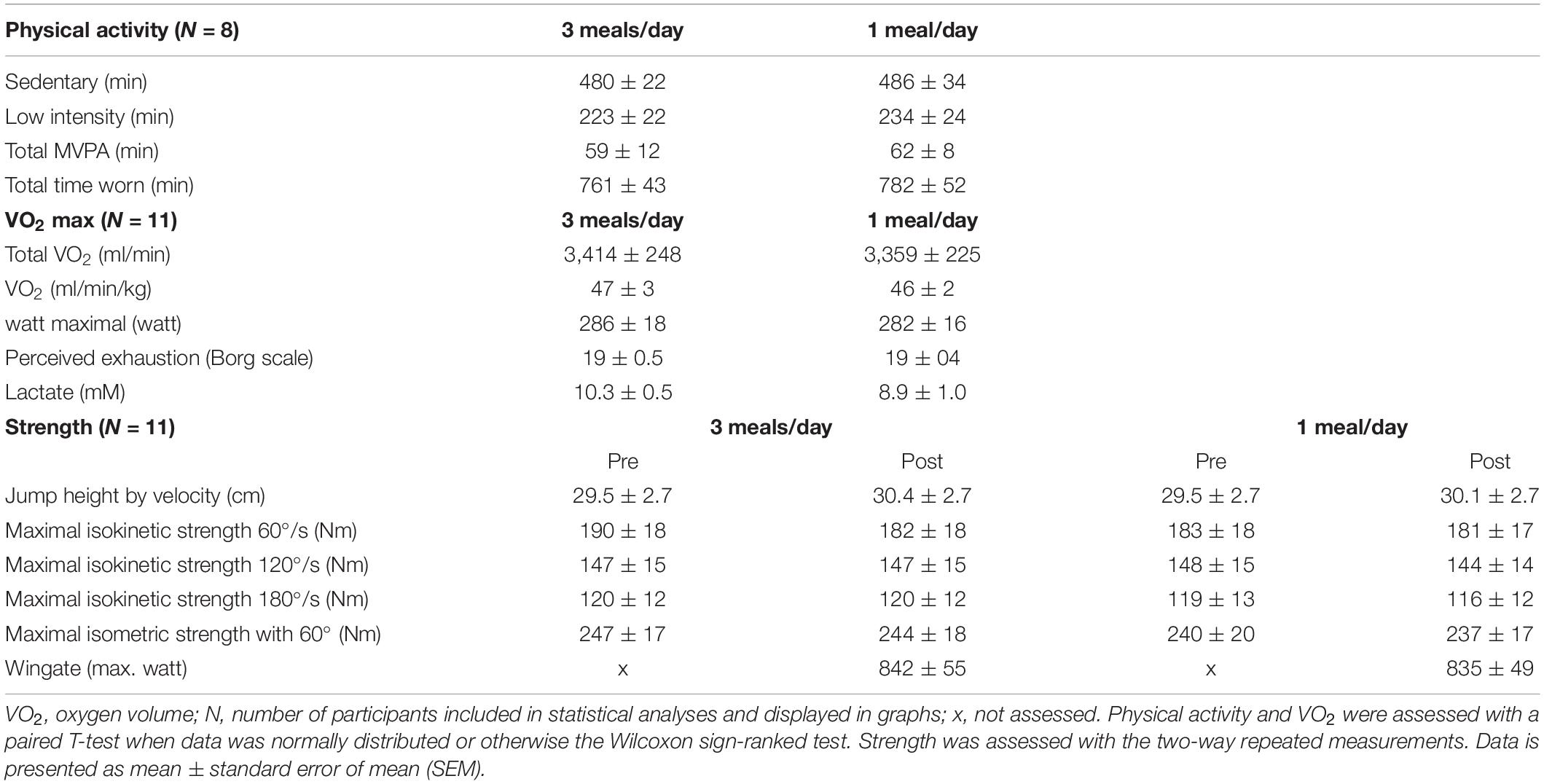
- Meessen, Emma & Andresen, Håvard & Barneveld, Thomas & Riel, Anne & Johansen, Egil & Kolnes, Anders & Kemper, E. & Olde Damink, Steven WM & Schaap, Frank & Romijn, Johannes & Jensen, Jørgen & Soeters, Maarten. (2022). Differential Effects of One Meal per Day in the Evening on Metabolic Health and Physical Performance in Lean Individuals. Frontiers in Physiology. 12. 10.3389/fphys.2021.771944.
Furthermore, in our practice, in every single patient who has lost more than 100 lbs., notably all of them utilize 4x/week resistance training. In addition, they also have demonstrated preserved lean mass on bioimpedance scales.
Bottom Line: We suspect some of the data showing decreases in lean mass from late intermittent fasting is actually demonstrating the deleterious effects of late-eating on sleep quality and sleep disturbance.
-
Humaira Jamshed, PhD; Felicia L. Steger, PhD; David R. Bryan, MA; et al. (2022) Effectiveness of Early Time-Restricted Eating for Weight Loss, Fat Loss, and Cardiometabolic Health in Adults With Obesity. Read the Jamshed trial
-
Large protein boluses during recovery from exercise and muscle protein synthesis
The anabolic response to protein ingestion during recovery from exercise has no upper limit in magnitude and duration in vivo in humans
Trommelen, J, van Lieshout, G, Nyakayiru, J., et. al. (2023) https://www.cell.com/cell-reports-medicine/fulltext/S2666-3791(23)00540-2
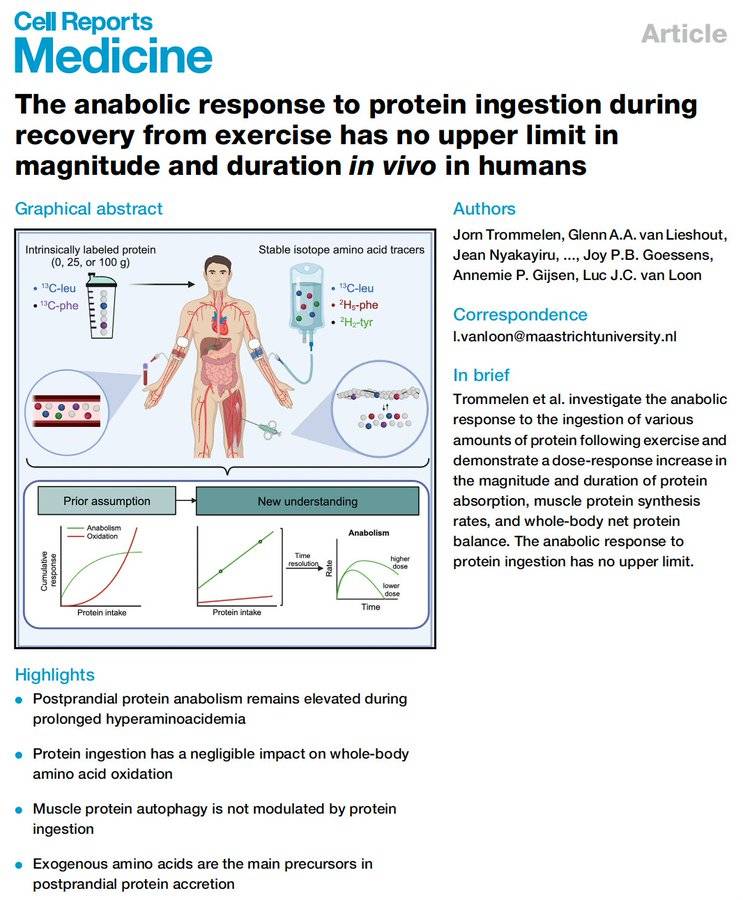 Graphical abstract of a human study on protein ingestion and recovery from exercise. Open full-size image
-
Time-Restricted Eating Does Not Reduce Lean Mass In Athletes
Effects of Time-Restricted Eating on Aerobic Capacity, Body Composition, and Markers of Metabolic Health in Healthy Male Recreational Runners: A Randomized Crossover Trial
Optimal nutrition is highly valuable for athletes aiming at maintaining or improving body composition and sports performance. When combined with structured exercise, time-restricted energy intake may represent an effective nonpharmacological approach to achieving these results. Correia, J, Pezarat-Correia, P, Minderico, C., etc. al https://pubmed.ncbi.nlm.nih.gov/38242204/