
Medically reviewed by Dr. Tro Kalayjian and Dr. Laura Buchanan
Reviewed by Amy Eiges, Certified Health Coach
Reading Nutrition and Ingredient Labels
Every day, supermarket shelves are filled with new convenience products that seem to be low carb and keto friendly. With words like “only 2 net carbs” splashed across the front, it’s easy to be fooled by marketing and cleverly worded packaging.
Use the examples below in the same order each time: check the serving size and total carbohydrates, read the ingredient list, then compare what the front of the package promises with what the full label shows. The pictured labels provide the examples for each comparison.
Cauliflower Pizza Crusts
Cauliflower’s mild flavor makes it common in low-carb replacement foods, but the name alone does not tell you what else is in the crust. The two labels shown here illustrate why it helps to compare both ingredients and carbohydrates.
The first one, CauliPower, has 28g of carbohydrates per serving and many ingredients that are not keto friendly. For instance, the second and third ingredients are brown rice flour and rice flour, then corn starch, tapioca starch and sunflower oil, and further down the list? Sugar.

The front of the box emphasizes cauliflower as the first ingredient. That claim does not describe the other leading ingredients: grains and starches.
These carbohydrate sources can cause significant glycemic (blood sugar) responses and in return residual hunger and cravings. Sunflower oil, a seed oil commonly found in processed foods, can cause inflammation, and also increase blood sugar fluctuations. With those on a ketogenic diet looking to keep their total carbs to under 30g a day, just one third of this moderately-sized crust contains nearly a full-days allotment.

Compare CauliPower to the brand Cali’flour – a nearly identical looking product, but the latter has only 3g carbs for the same size serving and what most would consider healthy and keto-friendly ingredients.
Psyllium husk is the only ingredient on this list that may not be widely known – it is a soluble fiber often used as a grain substitute in low-carb baking because it has a low glycemic index, meaning it will have a relatively small impact on your blood sugar.
None of the ingredients on Cali’flour’s list are known to cause a glycemic response, and unless you are dairy-sensitive, will mostly likely not cause any inflammation.
The name of the food is only the starting point; the label is what lets you compare the products.
(No) Sugar Cookies
If you just looked at the front of the Lakanto Sugar Free Cookie Mix, you might think this is an optimal choice for a ketogenic lifestyle. Boasting just “1 Net Carb” and “Sweetened with Monk Fruit,” it seems like a perfect option if you want to indulge.
However, the ingredients list tells a different story. Tapioca fiber, sugarcane fiber, chick pea flour and brown rice are all known to cause extreme blood sugar fluctuations. So, while the net carbs may be low, sugar and grains are very much present and can wreak havoc on your diet, hunger, cravings, and inflammation.


Compare that to ROSETTE’S (No) Sugar Cookie Mix which has a similar net carb count as Lakanto’s, but a much different picture in terms of ingredients. Not only is the total carb count 3g less in ROSETTE’S, but the ingredients list is significantly pared down.
Whey protein isolate (an ingredient used in many protein powders) and guar gum, the only two ingredients that may be unfamiliar to some have not been known to cause blood sugar fluctuations or inflammation in most people and are often added in low-carb confections. They serve as a substitute for gluten because they improve the texture and consistency of baked goods, giving the dough a springy feel and bite like those made with wheat flour.
Low-Carb Bread
Low-carb bread presents the same comparison. The labels for Arnold’s Keto Bread and Thin Slim’s Zero Net Carb Bread show why a claim on the front needs to be read alongside the ingredient list.
Modified wheat starch, wheat protein isolate, vital wheat gluten, oat fiber, soluble corn fiber? These are all grain sources with high glycemic indicators. While the total carb counts are all manageable on a limited basis, they are also likely to cause blood sugar spikes especially in those with diabetes or insulin resistance.
Additional ingredients like soybean oil, similar to sunflower oil described above, can be highly inflammatory and detrimental to health.


Net carbs = total carbs minus fiber
By abusing the principles of net carbs, manufacturers boast a low calculated net count by adding in extra fiber to bring the net carb count down. But the body responds to the net carb count of this highly processed food very differently than it does to, for instance, green vegetables with their naturally occurring fiber.

Base Culture Keto Bread is another brand that is becoming more readily available in the marketplace. Base Culture contains arrowroot flour, a gluten- and grain-free powder used as a thickening agent.
The total carbs in all of these breads are similar and certainly within range to be consumed on a low-carb or ketogenic approach, but what is inside makes all the difference in terms of health and our body’s response to eating them.
Pancake Batter Mix
The huge disparity in ingredient quality and carb counts can be seen dramatically in comparing Lakanto’s Pancake & Baking Mix, King Arthur’s Carb-Conscious Pancake Mix and ROSETTE’S Batter Mix.
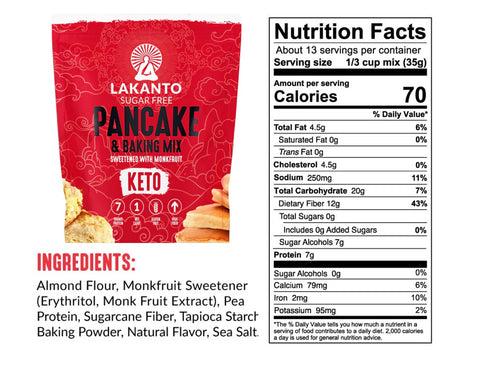

The Lakanto and King Arthur products are both marketed to keto and low-carb customers, and yet the total carb count for just 1/3 of a cup of mix is around half of one’s daily allotment on a ketogenic diet. The ingredients lists are filled with high glycemic index foods: pea protein, sugarcane fiber, tapioca starch, wheat gluten, chickpea flour, soluble corn fiber.
Compare this to ROSETTE’S with a lower total carb count and short, easily identifiable list of clean ingredients.

The biggest takeaway here is how crucial it is to turn every package over and read both the nutrition information and the list of ingredients. If you are concerned with your health and maintaining blood sugar control, the ingredients are nearly as important as the carb counts. While many of these products are not necessarily weight loss foods, sticking with non-inflammatory and low glycemic ingredients will enable your body to heal and give you safe ways to indulge without derailing your weight loss and health goals.
Article adapted from ROSETTE’S Baking Mixes BETTER Blog.
Hidden sugars, starches and ingredients to be avoided
The comparisons above show why ingredient names matter alongside serving size and carbohydrate counts. Use the reference list below when checking a package, including names that may be less familiar than the word “sugar.”
- Agave
- Arrowroot (flour, starch)
- Barley
- Beet Sugar
- Brown rice (flour, starch, sugar)
- Cane syrup
- Cassava (flour, starch)
- Coconut sugar
- Corn (flour, sugar, starch, syrup)
- Corn soluble fiber
- Dates (sugar)
- Dextrin
- Dextrose
- Fructose
- Fruit Juice (concentrate)
- Glucose
- High-fructose corn syrup
- Honey
- Lactose
- Malt (syrup)
- Maltitol
- Maltodextrin
- Maltose
- Maple Syrup
- Molasses
- Nectar
- Oat (flour, starch)
- Palm sugar
- Pea (protein, flour, starch)
- Potato (flour, starch)
- Raw sugar
- Rice (flour, starch, syrup)
- Sorbitol
- Soy (protein, flour, starch)
- Sucrose
- Sugar (in any form except “Sugar Alcohols”)
- Syrup
- Tapioca (flour, starch)
- Turbinado (starch, sugar)
- Wheat (in any form)
- Wheat gluten