
Intermittent fasting and time-restricted eating can feel more manageable when you start gradually. These five steps can help you prepare, recognize hunger, and build a fasting routine that fits your health needs.
Time-restricted eating is a form of intermittent fasting that keeps meals within a consistent daily window. Research suggests that this structure can support weight loss, insulin sensitivity, blood pressure, and other measures of metabolic health in some people.[1–5] The practical goal is not to make eating as difficult as possible. It is to reduce constant eating and snacking while still eating satisfying, nutrient-dense meals.

Step 1: Get medical advice before you start
Review your medical history and medications with your clinician before beginning a fasting routine. Changing meal timing can change blood glucose, blood pressure, hydration, and medication needs—sometimes quickly.
This planning is especially important if you use insulin, a sulfonylurea, or another medication that can cause low blood glucose. People with type 1 diabetes, people who are pregnant or breastfeeding, anyone who is underweight or medically frail, people younger than 18, and anyone with a current or previous eating disorder should discuss whether and how fasting fits their situation. Do not reduce or stop medication on your own.
Fasting is not automatically off-limits for everyone using diabetes medication. In the INTERFAST-2 randomized trial, adults with insulin-treated type 2 diabetes completed three nonconsecutive fasting days each week with dietary counseling and continuous glucose monitoring. They reduced A1C, body weight, and total daily insulin dose, with no severe hypoglycemia reported.[5] The important lesson is to make a plan before the first fast.
Step 2: Make meals more satisfying
Fasting is harder when meals leave you hungry. Before narrowing your eating window, reduce added sugars and refined carbohydrates and build meals around protein, naturally occurring fats, and fiber-rich whole foods.
Useful options include beef, poultry, fish, seafood, eggs, lamb, unsweetened yogurt, cheese, non-starchy vegetables, and lower-sugar fruits such as olives, avocado, cucumber, and peppers. Choose foods you tolerate and enjoy rather than trying to follow a perfect menu.
Protein has a strong satiating effect. In a controlled feeding study, increasing protein from 15% to 30% of energy increased satiety and reduced spontaneous food intake.[6] Ketosis may also change the appetite response to weight loss. In a human intervention by Sumithran and colleagues, the rise in ghrelin and subjective appetite that commonly follows weight loss was mitigated while participants remained ketotic.[7] These findings help explain why a protein-forward, lower-carbohydrate approach can make longer gaps between meals feel easier for some people.

Step 3: Start slowly
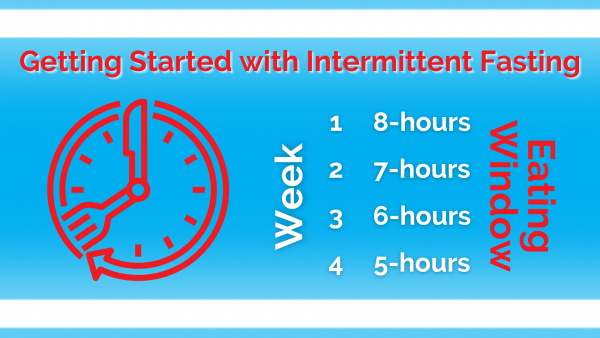
You do not need to begin with a multi-day fast. A simple first step is to stop eating between meals. Next, delay your first meal by 30 minutes or an hour, or close the kitchen a little earlier in the evening.
When that feels comfortable, try a consistent 10-hour or 8-hour eating window. If you want to experiment with a shorter window and your medical plan allows it, narrow the window by 30 to 60 minutes at a time. You do not have to force a 4-hour window to benefit from a more consistent eating pattern.
This gradual approach comes directly from an earlier Toward Health coaching discussion with Dr. Tro Kalayjian and Health Coaches Brian Wiley and Amy Eiges. They also recommended planning for the times and places that tend to be difficult—for example, closing the kitchen after dinner, staying busy, or beginning a project when habitual snacking usually starts.
Step 4: Learn what hunger feels like
Hunger often rises and falls rather than increasing in a straight line. When it appears, pause before deciding what to do. Drink water, unsweetened tea, black coffee, or plain seltzer if those choices fit your health plan, then reassess how you feel.
Notice whether the signal is physical hunger, thirst, habit, boredom, stress, or a cue tied to a particular time or place. This is information, not a test of character. If hunger continues, you feel unwell, or your glucose reaches the action point in your medical plan, end the fast and respond appropriately.

Step 5: Break the fast with a real meal
Fasting should not become a competition to see how long you can avoid food. Break the fast with a satisfying meal built around protein and nutrient-dense foods. Eat enough during your eating window rather than grazing continuously or treating the end of a fast as permission to eat past comfortable fullness.
Pay attention to energy, mood, sleep, training, hunger, and any medical measurements you track. If fasting consistently feels punishing or makes you feel unwell, stop and speak with your clinician. A useful fasting routine should make your life and eating pattern simpler—not consume your attention.
What the fasting research adds
Different fasting studies test different schedules, populations, and food plans, so they should not be treated as one identical intervention.
- In a controlled crossover trial, a 6-hour early eating window improved insulin sensitivity, beta-cell responsiveness, blood pressure, oxidative stress, and appetite in men with prediabetes even though the researchers maintained body weight.[1]
- In a 14-week randomized trial, an 8-hour early eating window added to weight-loss treatment produced greater weight loss and improved diastolic blood pressure and mood compared with a 12-hour-or-longer window.[2]
- In the 2026 TREAD randomized trial, adults with obesity using a personalized 10-hour window lost an average of 4.59 kg over 12 weeks, compared with 1.68 kg with standard dietary counseling. The additional loss was primarily body fat.[3]
- In a 2024 controlled feeding trial in which both groups received the same calories and nutrients, a 10-hour eating window did not produce additional weight loss or glycemic improvement.[4] This helps clarify how fasting can work in practice: meal timing may have direct metabolic effects in some settings, while reduced eating opportunities and changes in total intake remain important in others.
The best starting schedule is one you can follow consistently, evaluate honestly, and coordinate with your medical care when needed.
If you would like help building a sustainable fasting plan—or need medication and glucose monitoring coordinated as your eating changes—talk with the Toward Health team.
References
- Sutton EF, Beyl R, Early KS, Cefalu WT, Ravussin E, Peterson CM. Early time-restricted feeding improves insulin sensitivity, blood pressure, and oxidative stress even without weight loss in men with prediabetes. Cell Metabolism. 2018;27(6):1212-1221.e3. doi:10.1016/j.cmet.2018.04.010
- Jamshed H, Steger FL, Bryan DR, et al. Effectiveness of early time-restricted eating for weight loss, fat loss, and cardiometabolic health in adults with obesity: a randomized clinical trial. JAMA Internal Medicine. 2022;182(9):953-962. doi:10.1001/jamainternmed.2022.3050
- Wilkinson MJ, Padilla E, Wang Y, et al. Time-restricted eating promotes weight loss and favorable changes in adipose in obesity: the TREAD randomized control trial. Obesity. 2026;34(7):1395-1408. doi:10.1002/oby.70228
- Maruthur NM, et al. Effect of isocaloric, time-restricted eating on body weight in adults with obesity: a randomized controlled trial. Annals of Internal Medicine. 2024;177(5):549-558. doi:10.7326/M23-3132
- Obermayer A, Tripolt NJ, Pferschy PN, et al. Efficacy and safety of intermittent fasting in people with insulin-treated type 2 diabetes (INTERFAST-2)—a randomized controlled trial. Diabetes Care. 2023;46(2):463-468. doi:10.2337/dc22-1622
- Weigle DS, Breen PA, Matthys CC, et al. A high-protein diet induces sustained reductions in appetite, ad libitum caloric intake, and body weight despite compensatory changes in diurnal plasma leptin and ghrelin concentrations. American Journal of Clinical Nutrition. 2005;82(1):41-48. doi:10.1093/ajcn.82.1.41
- Sumithran P, Prendergast LA, Delbridge E, et al. Ketosis and appetite-mediating nutrients and hormones after weight loss. European Journal of Clinical Nutrition. 2013;67(7):759-764. doi:10.1038/ejcn.2013.90