
Pizza. Chocolate. Ice cream. Cookies. Cake. Doughnuts. French fries. Chips. Cheeseburgers. Macaroni and cheese.
People often describe these foods as personal weaknesses, but the pattern is remarkably consistent. The foods that are hardest to stop eating are rarely plain carbohydrate or plain fat. They are usually highly processed combinations of refined carbohydrate and fat, often with salt, flavoring, and a texture designed for rapid eating.
That combination matters. It can make food more rewarding, increase the drive to keep eating, and create a powerful desire for food even when the body has already received substantial energy.[1-5]
This is not proof that every person will react to every food in the same way. It is a reason to stop treating hunger and cravings as simple failures of character. The food itself can be engineered—or prepared—to produce a stronger reward signal.
Hunger and food reward are not the same signal
Hunger is the biological drive to obtain energy and nutrients.
Satiation helps end a meal. Satiety helps keep hunger quiet after the meal.
Food reward is the value the brain assigns to obtaining and consuming a food. Reward includes both the pleasure of eating and the motivation—the “wanting”—that pulls us toward the next bite.
These systems interact, but they do not always move together. A person can be physically full and still want dessert. A food cue can create urgency without an empty stomach. A highly rewarding food can make it difficult to notice that satiation has already arrived.
Understanding that distinction is important for weight loss. The goal is not merely to fit fewer calories onto a plate. It is to choose foods and build an environment that reduce the biological pressure to keep eating.
The foods people struggle with share a recognizable pattern
Ashley Gearhardt and colleagues used the Yale Food Addiction Scale to study which foods people most often associated with addictive-like eating.[1]
Highly processed foods ranked highest. Processing itself was strongly associated with problematic eating ratings. Higher fat content and higher glycemic load—the amount and speed of absorbable carbohydrate delivered by a serving—were also strong predictors.
The list looked familiar: chocolate, ice cream, French fries, pizza, cookies, chips, cake, buttered popcorn, cheeseburgers, muffins, sugary cereal, and similar foods. These are not simply “carbs,” and they are not simply “fat.” Most combine rapidly absorbed carbohydrate with fat in a form that is easy to chew, swallow, and eat quickly.
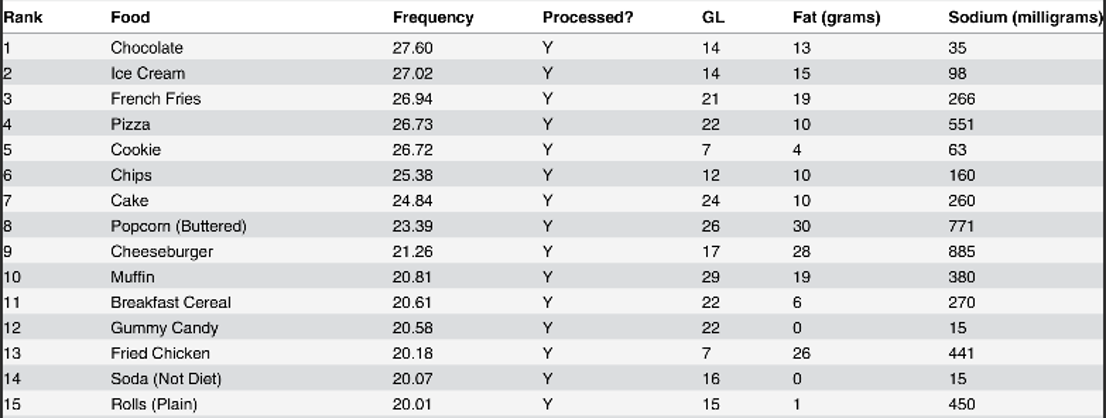
This pattern helps explain why plain boiled potatoes may not produce the same drive as French fries, why bread becomes harder to stop eating when combined with butter, and why pasta becomes more rewarding when turned into macaroni and cheese. The combination changes the experience.
Carbohydrate plus fat produces a stronger reward signal
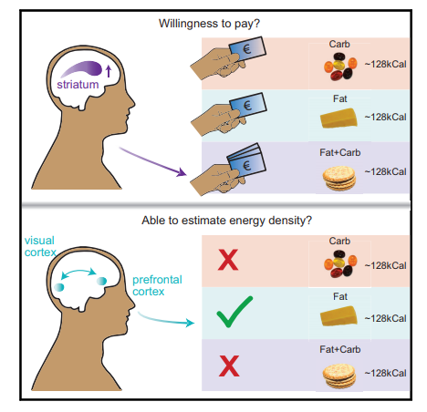
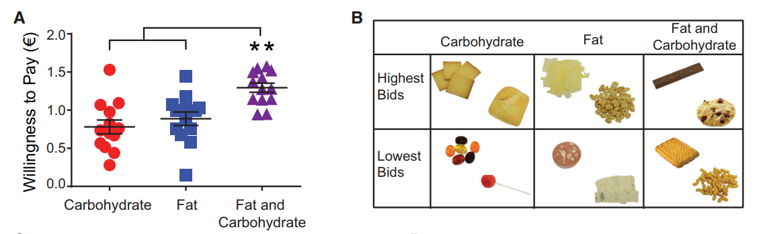
In a controlled study, Alexandra DiFeliceantonio and colleagues used an auction task and functional MRI to compare foods containing mostly fat, mostly carbohydrate, or both fat and carbohydrate.[2]
Participants were willing to pay more for the combined foods than for equally familiar, equally liked, and equally caloric foods containing primarily fat or carbohydrate. The combined foods also produced greater activity in brain regions involved in reward valuation, including the dorsal striatum and mediodorsal thalamus.
In other words, the brain did not simply add the reward from carbohydrate to the reward from fat. The combination produced a supra-additive effect: together, they were valued more than either nutrient alone.
That is why common trigger foods so often combine refined flour or sugar with oil, butter, cream, or cheese. The reward comes from the complete package, not from one isolated ingredient.
Mixed foods can also change appetite-related hormones
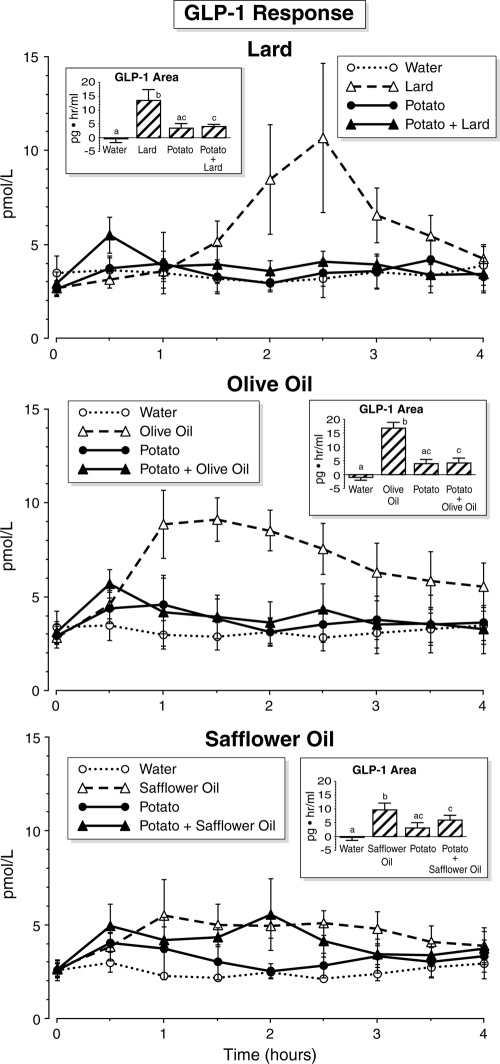
The research includes a controlled feeding study by Radulescu, Gannon, and Nuttall.[3] Healthy adults consumed potato, one of three isolated fats, a fat combined with potato, or water while researchers measured glucagon, GLP-1, and ghrelin over four hours.
Fat alone produced the greatest GLP-1 response and reduced both total and active ghrelin. When potato was added to the fat, the fat-stimulated increase in GLP-1 was eliminated and the suppression of active ghrelin was largely negated. The interaction between carbohydrate and fat changed the hormonal response rather than simply producing the sum of two independent effects.
This is consistent with the lived experience that a mixed, highly rewarding food can deliver substantial energy without producing the stopping signal a person expected.
“Hyper-palatable” describes combinations, not a moral category
Researchers use the term hyper-palatable food for foods containing specific combinations of fat, sugar, carbohydrate, or sodium that may make them especially easy to consume.[4]
The term should not be used as a moral judgment. It does not mean that fat, carbohydrate, or salt is inherently bad, and it does not mean that every processed food affects every person identically. It describes a nutrient pattern that can intensify palatability and reward.
That distinction matters. Meat, eggs, olives, avocado, and cheese contain fat, but they do not deliver the same refined-carbohydrate-and-fat signal as doughnuts or pizza. Potatoes and fruit contain carbohydrate, but they do not necessarily create the same eating experience as French fries or ice cream. The food matrix, processing, texture, protein, fiber, energy density, speed of eating, and individual response all matter.
Highly processed foods can make people eat more without intending to
In an NIH inpatient randomized crossover trial, 20 adults were offered either an ultra-processed or an unprocessed diet for two weeks and then crossed over to the other diet.[5] The presented diets were matched for several listed nutrients, and participants were told to eat as much or as little as they wanted.
On the ultra-processed diet, participants ate about 500 more calories per day and gained weight. On the unprocessed diet, they ate less and lost weight.
This does not mean that every ultra-processed food works through the same mechanism. It does demonstrate that the form and composition of food can change spontaneous intake even when people are not instructed to overeat.
The practical lesson is simple: if a food repeatedly makes it hard for you to stop, that reaction is meaningful information. You do not have to keep proving that you can control it through willpower alone.
Use replacement strategies instead of relying on restraint
The most useful response to a trigger food is not shame. It is a replacement plan.
1. Identify the complete trigger pattern
Do not look only for “sugar” or only for “fat.” Notice whether the foods that pull you back combine refined carbohydrate, fat, salt, intense flavor, and a texture that allows rapid eating.
2. Build meals around protein and satiety
Start with an adequate serving of protein, then add minimally processed foods that fit your nutritional plan. A meal that reliably produces satiety is a stronger defense than trying to resist a trigger food while hungry.
3. Replace the experience, not just the ingredient
If the urge is for something crunchy, salty, creamy, warm, convenient, or comforting, choose a replacement that addresses that experience. A technically compliant food that does not meet the real need is unlikely to work when the craving is strong.
4. Change access before the urge arrives
Make trigger foods less available and useful alternatives easier to reach. Environment is part of treatment. A planned refrigerator, pantry, restaurant order, or travel snack reduces the number of decisions that must be made under pressure.
5. Treat a lapse as data
Ask what preceded it: hunger, stress, poor sleep, alcohol, a glucose swing, a social setting, food availability, or an emotional cue. Then change the plan at the earliest point in that sequence.
6. Use the level of carbohydrate restriction that quiets your hunger
For many people, reducing sugar, refined grains, and other rapidly absorbed carbohydrates removes one half of the most rewarding food combination and makes appetite more predictable. The correct level is the one that is medically appropriate, nutritionally complete, and sustainable for the individual.
People taking insulin, sulfonylureas, or other medications that can cause hypoglycemia should work with a clinician before substantially reducing carbohydrate because medication needs can change quickly.
The goal is not perfect control—it is less biological pressure
If pizza, cookies, ice cream, French fries, or similar foods have felt unusually difficult to stop eating, you are not uniquely weak. These foods share properties that repeatedly activate human reward systems.
Understanding food reward changes the question from “Why can’t I control myself?” to “What combination is driving this response, and what can I put in its place?”
That is a far more useful question. It leads to better meals, better environments, and better replacement strategies—so that eating well requires less constant resistance.
Watch: What Does the Brain Crave? What Is Food Reward?
Dr. Tro Kalayjian’s complete original 8-minute, 48-second video is included with this article.
Video: Food Reward & Other Hunger Signals
References
- Schulte EM, Avena NM, Gearhardt AN. Which foods may be addictive? The roles of processing, fat content, and glycemic load. PLOS ONE. 2015;10(2):e0117959. doi: 10.1371/journal.pone.0117959.
- DiFeliceantonio AG, Coppin G, Rigoux L, et al. Supra-additive effects of combining fat and carbohydrate on food reward. Cell Metabolism. 2018;28(1):33-44.e3. doi: 10.1016/j.cmet.2018.05.018.
- Radulescu A, Gannon MC, Nuttall FQ. The effect on glucagon, glucagon-like peptide-1, total and acyl-ghrelin of dietary fats ingested with and without potato. Journal of Clinical Endocrinology & Metabolism. 2010;95(7):3385-3391. doi: 10.1210/jc.2009-2559. Original Disciple study link.
- Fazzino TL, Rohde K, Sullivan DK. Hyper-palatable foods: development of a quantitative definition and application to the US food system database. Obesity. 2019;27(11):1761-1768. doi: 10.1002/oby.22639.
- Hall KD, Ayuketah A, Brychta R, et al. Ultra-processed diets cause excess calorie intake and weight gain: an inpatient randomized controlled trial of ad libitum food intake. Cell Metabolism. 2019;30(1):67-77.e3. doi: 10.1016/j.cmet.2019.05.008.