
Medically reviewed by Dr. Tro Kalayjian and Dr. Laura Buchanan.
If the scale is the only way you judge exercise, you may miss some of its most important effects.
Exercise alone usually produces modest average weight loss. Yet the same movement can improve depression and anxiety symptoms, cardiorespiratory fitness, strength, body composition, glucose regulation and the day-to-day capacity to handle stress. It can also help people protect the weight they have already lost.
The better question is not simply, “How many calories did I burn?” It is, “What did this movement do for my brain and body?”
Exercise can meaningfully improve depression
The evidence for depression is substantial. A 2024 network meta-analysis included 218 randomized studies and 14,170 participants with major depression. Walking or jogging, yoga, strength training and mixed aerobic exercise all reduced depressive symptoms compared with active controls. Walking or jogging showed one of the largest average effects, while strength training and yoga were among the most acceptable forms of exercise.[1]
A 2025 meta-analysis focused specifically on resistance training pooled 29 randomized trials and 2,036 adults with clinically diagnosed depression. Resistance training reduced depressive symptoms compared with non-exercise controls, with benefits seen in both primary depressive disorders and depression occurring alongside other conditions.[13]
A broader 2026 synthesis combined 81 meta-analyses representing 1,079 component studies and 79,551 participants. Across populations and exercise formats, exercise reduced both depression and anxiety symptoms. Aerobic exercise produced the largest average improvement in that analysis, but the larger lesson is that several forms of movement work.[2]
This is not only review-level evidence. In the randomized SMILE trial, 202 adults with major depression were assigned to supervised exercise, home-based exercise, sertraline or placebo for 16 weeks. Remission occurred in 45% of the supervised-exercise group, 40% of the home-exercise group, 47% of the medication group and 31% of the placebo group. The exercise outcomes were comparable with sertraline, and the exercise groups also gained physical fitness.[3]
The larger REGASS trial tested exercise in routine primary care. Researchers randomized 945 adults with mild-to-moderate depression to supervised group exercise, clinician-supported internet-based cognitive behavioral therapy or usual physician care. At 12 months, depression severity had improved more in the exercise and internet-based therapy groups than with usual care, supporting prescribed exercise as a practical treatment option beyond a tightly controlled research setting.[14]
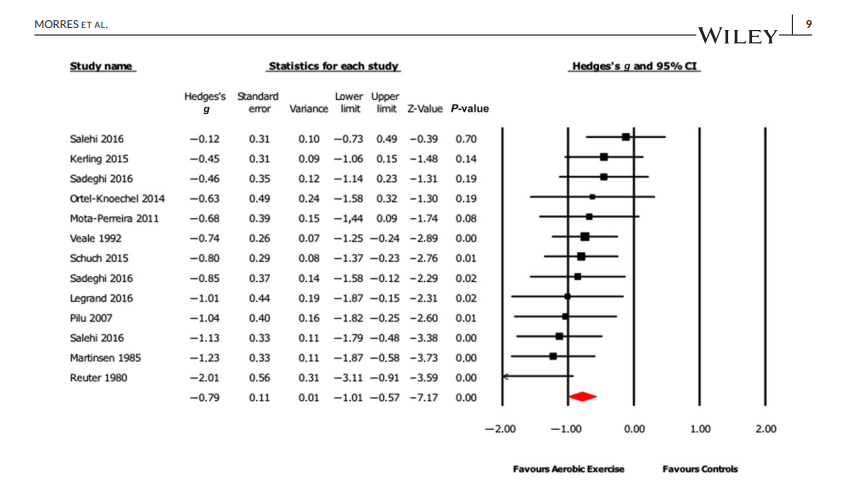
The original Toward Health article highlighted a meta-analysis of aerobic exercise delivered within mental-health services. Its pooled result also favored exercise for adults with major depressive disorder.[4]
Anxiety can improve too
Exercise is also a useful treatment component for anxiety. In a Swedish primary-care trial, adults with anxiety disorders were assigned to 12 weeks of low-intensity exercise, moderate-to-high-intensity exercise or standard care. Both exercise groups improved more than the control group, with anxiety scores falling by about five additional points and the odds of meaningful improvement rising in both exercise groups.[5]
A 2026 network meta-analysis of 30 randomized trials and 1,421 adults found that resistance training and mind-body exercise were particularly effective for anxiety disorders, while aerobic exercise also improved symptoms.[6] The practical implication is encouraging: walking, cycling, resistance training, yoga and mixed programs can all be reasonable choices. The most useful form is one a person can perform consistently and adjust to current energy, confidence and physical ability.
The brain response is more interesting than “happy hormones”
Exercise can change mood quickly, but the biology is not explained by a single endorphin switch.
The original article linked to a human brain-imaging study in which researchers used positron-emission tomography after rest, moderate cycling and high-intensity interval training. High-intensity exercise changed μ-opioid-receptor binding in brain regions involved in pain, reward and emotion, but it also increased negative feelings in some participants. After moderate exercise, greater euphoria was associated with the opioid response.[7] More intensity did not simply produce more happiness.
Another double-blind experiment offers a complementary clue. Sixty-three adults completed moderate treadmill running or walking after receiving either the opioid blocker naltrexone or placebo. Running increased euphoria, reduced anxiety and raised circulating endocannabinoids even when opioid signaling was blocked.[8]
Exercise may therefore influence mood through several interacting pathways: endocannabinoid and opioid signaling, autonomic regulation, sleep, inflammation, self-efficacy, social contact and the experience of doing something difficult and useful. Biology and behavior move together.
Exercise deserves credit even when weight changes slowly
The source article was right to warn against becoming “married to the scale,” but exercise is not irrelevant to weight loss. A 2024 dose-response meta-analysis of 116 randomized trials and 6,880 adults with overweight or obesity found that supervised aerobic exercise reduced body weight, waist circumference, body-fat percentage and visceral fat. The average weight change was modest, and larger improvements in waist and body fat generally required at least 150 minutes per week of moderate-to-vigorous exercise.[9]
There is also a biological reason the calorie math may disappoint. In a study of 332 adults from five populations, total energy expenditure rose with physical activity at lower activity levels but plateaued at higher levels after adjustment for body size and composition. The body appears to compensate for some added activity rather than adding every exercise calorie to daily expenditure indefinitely.[10]
That adaptation does not erase the value of exercise. It explains why exercise can improve fitness, mood, insulin action and body composition without producing a dramatic change on the scale.
Long-term weight-loss data point in the same direction. Among 2,886 members of the National Weight Control Registry followed for 10 years, decreases in leisure-time physical activity were associated with greater weight regain.[11] This was an observational cohort, so it does not prove that exercise alone caused maintenance. It does show that sustained movement was one of the behaviors that traveled with sustained success.
There may also be an important behavioral bridge between mental health and weight maintenance. When stress is unmanaged, some people cope through food, alcohol or withdrawal from routines. Exercise can create another response: a walk, a training session, time outdoors, social contact or a repeatable transition out of the stress cycle. That is a plausible way mood support can reinforce weight-maintenance behavior even when the workout itself is not producing large weight loss.
Low-carb nutrition and exercise can do different jobs
A short randomized trial in 74 young women with overweight illustrates why the scale should not be the only outcome. Participants followed a low-carbohydrate diet of about 50 grams of carbohydrate per day, with or without exercise, or continued their usual diet and activity for four weeks. Both low-carbohydrate groups lost about 3 kilograms and had substantial reductions in insulin, C-peptide and leptin. Adding exercise did not produce additional weight loss, but the exercise group improved peak aerobic fitness by about 15% and anxiety by about 25% compared with the low-carbohydrate-only group.[12]
The nutrition intervention moved weight and metabolic markers. Exercise added fitness and mental-health benefits. They were complementary, not redundant.
For a deeper discussion of ketogenic nutrition and depression, see the Toward Health article Can a Ketogenic Diet Help Depression?.
A practical way to begin
You do not need to identify the “perfect” exercise before starting. Use a simple structure:
- Choose one aerobic activity you can repeat, such as walking, cycling, swimming or jogging.
- Include strength training at least twice a week when possible.
- Keep an easier option for high-stress or low-energy days.
- Increase time or effort gradually instead of making every session punishing.
- Track mood, sleep, energy, strength and consistency alongside weight.
Some people feel better immediately after movement. For others, the more meaningful change appears after a routine has been repeated for several weeks. Both experiences are valid. Consistency matters more than chasing exhaustion.
Exercise can be used alongside psychotherapy, medication, nutrition, sleep support and other appropriate care. If depression or anxiety symptoms are severe, rapidly worsening or include thoughts of self-harm, seek professional help promptly. In the United States, call or text 988 for the Suicide & Crisis Lifeline.
Watch the separate companion video

Watch “Exercise for Metabolic and Mental Health: Choosing the Right Training” with Dr. Tro (7:16).
The bottom line
Exercise is not merely a calorie-burning tool. It can directly improve depression and anxiety symptoms, build fitness and strength, support metabolic health and help protect long-term weight loss. Those benefits count even when the scale barely moves.
Choose movement that fits your body and your life. Repeat it often enough to become part of how you manage mood, stress and health—not a punishment for what you ate.
References
- Noetel M, Sanders T, Gallardo-Gómez D, et al. Effect of exercise for depression: systematic review and network meta-analysis of randomised controlled trials. BMJ. 2024;384:e075847. PubMed · Full text · doi:10.1136/bmj-2023-075847 Added evidence.
- Munro NR, Teague S, Somoray K, et al. Effect of exercise on depression and anxiety symptoms: systematic umbrella review with meta-meta-analysis. British Journal of Sports Medicine. 2026;60(8):590–599. PubMed · doi:10.1136/bjsports-2025-110301
- Blumenthal JA, Babyak MA, Doraiswamy PM, et al. Exercise and pharmacotherapy in the treatment of major depressive disorder. Psychosomatic Medicine. 2007;69(7):587–596. PubMed · Full text · doi:10.1097/PSY.0b013e318148c19a
- Morres ID, Hatzigeorgiadis A, Stathi A, et al. Aerobic exercise for adult patients with major depressive disorder in mental health services: a systematic review and meta-analysis. Depression and Anxiety. 2019;36(1):39–53. PubMed · doi:10.1002/da.22842
- Henriksson M, Wall A, Nyberg J, et al. Effects of exercise on symptoms of anxiety in primary care patients: a randomized controlled trial. Journal of Affective Disorders. 2022;297:26–34. PubMed · doi:10.1016/j.jad.2021.10.006
- Lei EF-C, Wan K-W, Dai Z, Tam BT. Effectiveness and acceptability of exercise treatments for adults with anxiety disorders: a systematic review and network meta-analysis. BMJ Open Sport & Exercise Medicine. 2026;12:e002781. PubMed · Full text · doi:10.1136/bmjsem-2025-002781
- Saanijoki T, Tuominen L, Tuulari JJ, et al. Opioid release after high-intensity interval training in healthy human subjects. Neuropsychopharmacology. 2018;43(2):246–254. PubMed · Full text · doi:10.1038/npp.2017.148
- Siebers M, Biedermann SV, Bindila L, et al. Exercise-induced euphoria and anxiolysis do not depend on endogenous opioids in humans. Psychoneuroendocrinology. 2021;126:105173. PubMed · doi:10.1016/j.psyneuen.2021.105173
- Jayedi A, Soltani S, Emadi A, Zargar M-S, Najafi A. Aerobic exercise and weight loss in adults: a systematic review and dose-response meta-analysis. JAMA Network Open. 2024;7(12):e2452185. PubMed · Full text · doi:10.1001/jamanetworkopen.2024.52185
- Pontzer H, Durazo-Arvizu R, Dugas LR, et al. Constrained total energy expenditure and metabolic adaptation to physical activity in adult humans. Current Biology. 2016;26(3):410–417. PubMed · Full text · doi:10.1016/j.cub.2015.12.046
- Thomas JG, Bond DS, Phelan S, Hill JO, Wing RR. Weight-loss maintenance for 10 years in the National Weight Control Registry. American Journal of Preventive Medicine. 2014;46(1):17–23. PubMed · doi:10.1016/j.amepre.2013.08.019
- Hu M, Shi Q, Sun S, et al. Effect of a low-carbohydrate diet with or without exercise on anxiety and eating behavior and associated changes in cardiometabolic health in overweight young women. Frontiers in Nutrition. 2022;9:894916. PubMed · Full text · doi:10.3389/fnut.2022.894916
- Chang Y, Wang H, Zhang X, Shan S, Liu H. Resistance training for depression: a systematic review and meta-analysis of randomized controlled trials. Frontiers in Psychology. 2025;16:1655855. PubMed · Full text · doi:10.3389/fpsyg.2025.1655855
- Hallgren M, Helgadóttir B, Herring MP, et al. Exercise and internet-based cognitive-behavioural therapy for depression: multicentre randomised controlled trial with 12-month follow-up. British Journal of Psychiatry. 2016;209(5):414–420. PubMed · doi:10.1192/bjp.bp.115.177576