
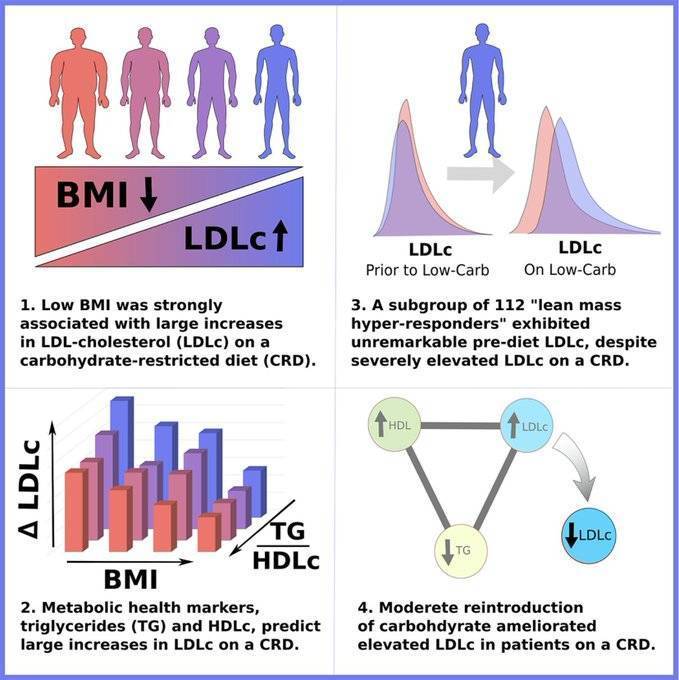
 Four-panel research graphic showing relationships among BMI, triglycerides, HDL and LDL changes during carbohydrate restriction. Open full-size imageA new paper recently co-authored by Dr. Tro Kalayjian, DO, found that having lower BMI and a lower TG/HDL ratio was associated with larger increases in LDL when beginning a low-carbohydrate diet. The paper also included a case series highlighting that this phenomenon may be at least partially reversible. According to Dr. Tro, “This study is the tip of the iceberg. If we can predict who will experience increases in cholesterol from a low carb diet and modify their approach, this is potentially something really useful.”
Published November 30, 2021 in Current Developments in Nutrition, the journal of the American Society for Nutrition, the report is entitled “Elevated LDL-cholesterol with a carbohydrate-restricted diet: evidence for a ‘lean mass hyper-responder phenotype.” The report demonstrates findings from an online survey collected by Dave Feldman and a case series of patients from Dr. Tro’s clinic. The conclusion states that “in contrast to the typical pattern of dyslipidemia, greater LDLc elevation on a carbohydrate-restricted diet tends to occur in the context of low cardiometabolic risk,” but the paper also emphasizes that the findings are early-stage and not generalizable. The other authors include Dr. Nicholas Norwitz, Dr. Adrian Soto-Mota, Dave Feldman and Dr. David Ludwig.
The patients from the case-series had all presented to Dr. Tro’s clinic with a primary concern about an elevated cholesterol level after they had independently started a ketogenic diet. Dr. Tro’s team gathered all prior medical records on these patients and noticed that all of them had prior lipid levels that were relatively normal. Each of these patients agreed to further testing including genetic testing and imaging tests which demonstrated that these patients were otherwise healthy. Each of these patients either refused conventional treatment including statin therapy or they did not tolerate them previously. Dr. Tro observed that the reintroduction of a modest amount of carbohydrates reduced their cholesterol substantially. One patient reduced cholesterol levels by over 480mg/dl, with the average reduction well over 100mg/dl.
The authors suggest that “patients with obesity and related disease may be at low risk of experiencing a clinically significant increase in cholesterol when adopting a low-carbohydrate diet, but that in contrast very lean, healthy, physically-active individuals may be uniquely susceptible to more dramatic increases.” Above all, the authors caution that more prospective and interventional studies are needed to confirm and explore these findings.
“This is some great early data that may be able to guide further research and potentially change clinical management of patients experiencing a high cholesterol level after starting a low carbohydrate diet,” said Dr. Tro. “I’d like to thank my co-authors, mentors, friends and family, but above all, I’d like to thank my patients for agreeing to share their data to the medical community.”
How our view of PCSK9 inhibitors changed:
Toward Health has re-evaluated PCSK9 inhibitors as the evidence has developed. Lowering LDL cholesterol, preventing cardiovascular events and reducing deaths are different outcomes. Our earlier concerns about mortality deserve to be explained alongside our current conclusion.
Early evidence, 2017–2019: FOURIER (2017) reduced major cardiovascular events but did not demonstrate a reduction in all-cause or cardiovascular mortality. Both were numerically higher with evolocumab: all-cause deaths were 3.2% versus 3.1%, and cardiovascular deaths were 1.8% versus 1.7%. Neither difference was statistically significant.
ODYSSEY OUTCOMES and its 2019 mortality analysis need a distinction: all-cause deaths were lower with alirocumab, 3.5% versus 4.1%, but the result was only nominally significant because the trial’s prespecified testing hierarchy had already stopped at a nonsignificant outcome. Cardiovascular mortality was not significantly reduced. The early trials therefore did not establish a consistent, definitive survival benefit across the class.
Why the mortality reanalysis concerned us: A BMJ Open reanalysis, submitted in 2021 and published in December 2022, found discrepancies in FOURIER death classifications using regulatory clinical-study reports. After readjudication, cardiovascular deaths were more frequent with evolocumab (relative risk 1.20; 95% confidence interval 0.95–1.51). This was a concerning signal, although it did not establish that the drug increased mortality. The investigators could not re-evaluate nonfatal events. We regarded the mortality and reporting questions as reasons for caution.
What changed our assessment: We have now reviewed the longer-term and newer evidence:
- FOURIER-OLE (2022) associated earlier evolocumab treatment with fewer cardiovascular events and cardiovascular deaths. These were exploratory comparisons of earlier versus delayed initiation; both groups received evolocumab during the extension.
- The long-term ODYSSEY OUTCOMES analysis (2023) supported sustained cardiovascular benefit and reassuring safety through follow-up of up to five years, with more injection-site reactions than placebo.
- VESALIUS-CV (2026; online 2025) strengthened the evidence in high-risk patients without a previous heart attack or stroke: five-year coronary death, heart attack or ischemic stroke risk was 6.2% versus 8.0%, an absolute difference of 1.8 percentage points.
After this reassessment, we agree that PCSK9 inhibitors such as alirocumab (Praluent) and evolocumab (Repatha) can be effective options for selected patients with coronary artery disease or other high-risk conditions. This updated position reflects the evolving evidence, while keeping cardiovascular-event reduction distinct from a claim of universal survival benefit.
For plaque regression, separate imaging trials, GLAGOV and PACMAN-AMI, found greater coronary plaque regression when a PCSK9 inhibitor was added to statin therapy. These findings do not establish that CAC scores will fall. Treatment remains individualized to disease burden, overall risk, existing therapy, tolerability and patient preferences.
Article Information:
https://www.youtube.com/watch?v=NOExItzKqBE