
Alcohol can affect more than the carbohydrate count of a drink. This guide looks at the considerations discussed by Toward Health’s clinical team: tolerance, appetite, sleep and beverage choices.
Alcohol tolerance and metabolism
At the end of the day, what makes us feel drunk is the level of alcohol circulating in our blood. Anything that slows down our body’s metabolism of alcohol makes us get drunk quicker and increases the absolute level of drunkenness we can reach.
Alcohol decreases our oxidation of all macronutrients, but particularly carbohydrates. This results in a double whammy where our bodies make more insulin to compensate for the decreased glucose disposal. It’s possible to see a near 50% increase in plasma insulin concentration even without seeing a significant change in glucose levels. Having extra insulin circulating subdues ketone synthesis and causes our bodies to start storing fat rather than burning it.
Whatever tolerance for alcohol you think you have, count on it being lower while on a ketogenic diet. Drinking too much can increase insulin resistance and fat accumulation.
Appetite and food choices
Tolerance is only part of the picture. Alcohol can also influence what you choose to eat and how satisfied you feel.
You’ve probably heard people say something along the lines of “I only smoke when I drink”. Eating more than you intended, or choosing foods you would otherwise avoid, can be part of that pattern. Alcohol alters our brain chemistry, reducing our body’s sensitivity to feeling full. This is another potentially potent double-whammy. First, we are more likely to eat foods that we should be avoiding in the first place (for example, carbohydrate dense processed foods like chips). Secondly, we will be able to eat more than we usually would in order to reach the same level of satiety (sense of feeling “full”).
For some people, having a “cheat” night once a month during which they drink and eat processed carbohydrates might be okay. However, this is a very slippery slope. In our experience, it is all too common for one cheat night to become a catalyst for problems in the future.
Alcohol and sleep
Everyone knows you shouldn’t drink alcohol while pregnant. Alcohol may help you fall asleep faster while leaving you with less restorative sleep. Even a single glass of wine, if consumed within a few hours of bed, can disrupt your sleep.
The red line shows what a typical heart rate trend might look like after drinking 1-2 glasses of wine, while the green line shows what we would expect with no alcohol consumption. 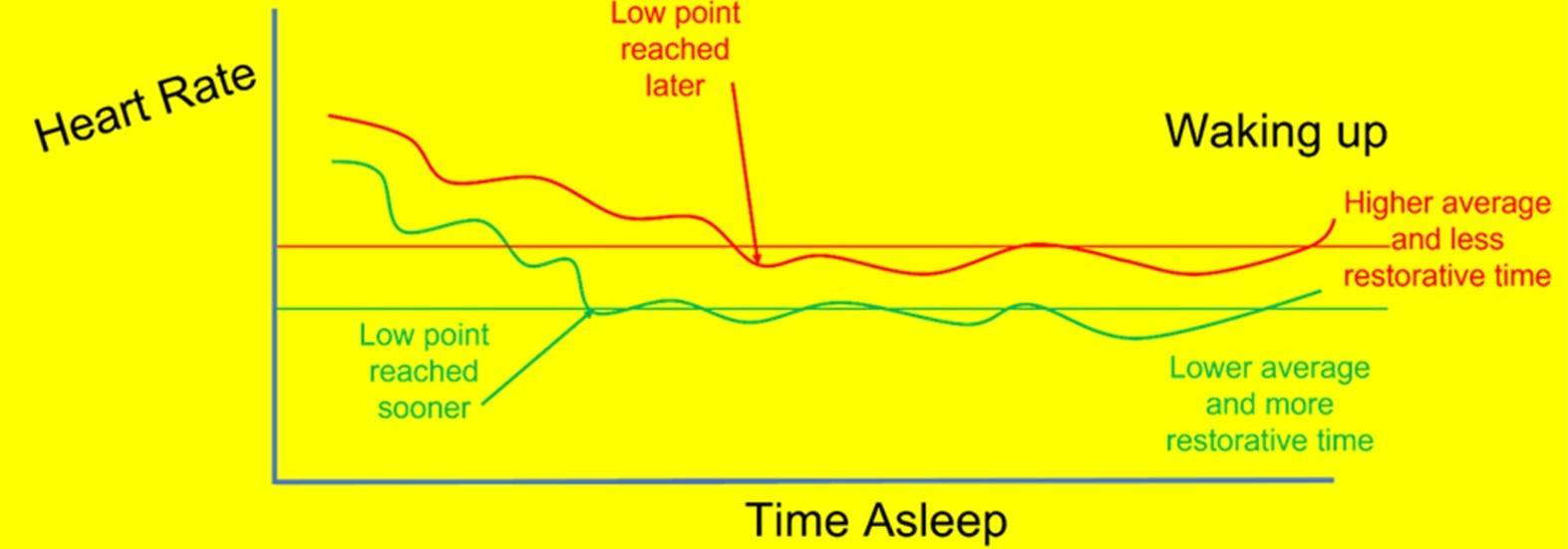 Illustrative heart-rate curves during sleep, contrasting earlier and later low points. Open full-size image
When we fall asleep, our heart rate begins to decrease. At a certain point, it begins to fluctuate around a stable average where it will stay until we wake up. Everyone has a different resting heart rate, but more importantly, everyone also has a “lowest possible” resting heart rate for their own body. Good sleep means achieving the lowest heart rate possible for our unique bodies, and spending as much time hovering around the stable average as we can.
In addition to interfering with our resting heart rate, alcohol decreases the quality and duration of our REM and deep sleep phases. It also makes us more likely to sleep restlessly (for example, by increasing the number of times we roll-over). It also increases the likelihood and frequency of waking to urinate.
Sleep quality is the single most impactful variable that determines our energy levels during the day. Poor sleep doesn’t just make us tired; it also impacts our mood and temperament. For example, we know that a lack of sleep can lead to increased production of hunger hormones like ghrelin, and the stress hormone cortisol. Higher stress and an increased appetite both make it far more difficult to stick with lifestyle changes, particularly if you have just gotten started.
If you choose to drink
First, everything in moderation. One drink is better than two, and two is better than four. If you are planning on drinking more than one drink, try to intersperse a glass of water between them. And, if you know that you may have trouble stopping after two drinks then it is seriously worth considering abstaining instead. Keep the lower tolerance discussed above in mind when deciding whether to have another drink.
Second, try to stop drinking at least 2-3 hours before bed. Keep in mind that the more time between your last drink and when you go to bed, the better.
Third, if you can tolerate it, dilute your beverage! It may sound sacrilegious, but one thing we have found to be particularly effective is adding lots of ice to your beverage. Instead of filling up a glass of wine all the way, fill it halfway and then use ice to top it off. You’ll probably be surprised at how quickly you adapt to the new taste and experience. This same principle can be applied to virtually any beverage – it’s up to you to explore and figure out what you like best. Trust us, it will be worth the time spent investigating!
Lastly, if you plan on driving, please be cautious. With the increased effects of alcohol on a ketogenic diet, this is even more important than normal. Additionally, there have been reports that people in nutritional ketosis have gotten false positive results on certain models of breathalyzers.
Comparing beverage choices
The alcoholic beverages you should avoid the most are sugary coolers, which can have more than 220 calories per bottle and 25-40 (or more) grams of carbs. Coolers have a huge amount of variability so it is crucial to check the content of each one if that’s what you are determined to drink. Liquor, wine and beer options are more consistent by type, and we’ve highlighted them below.
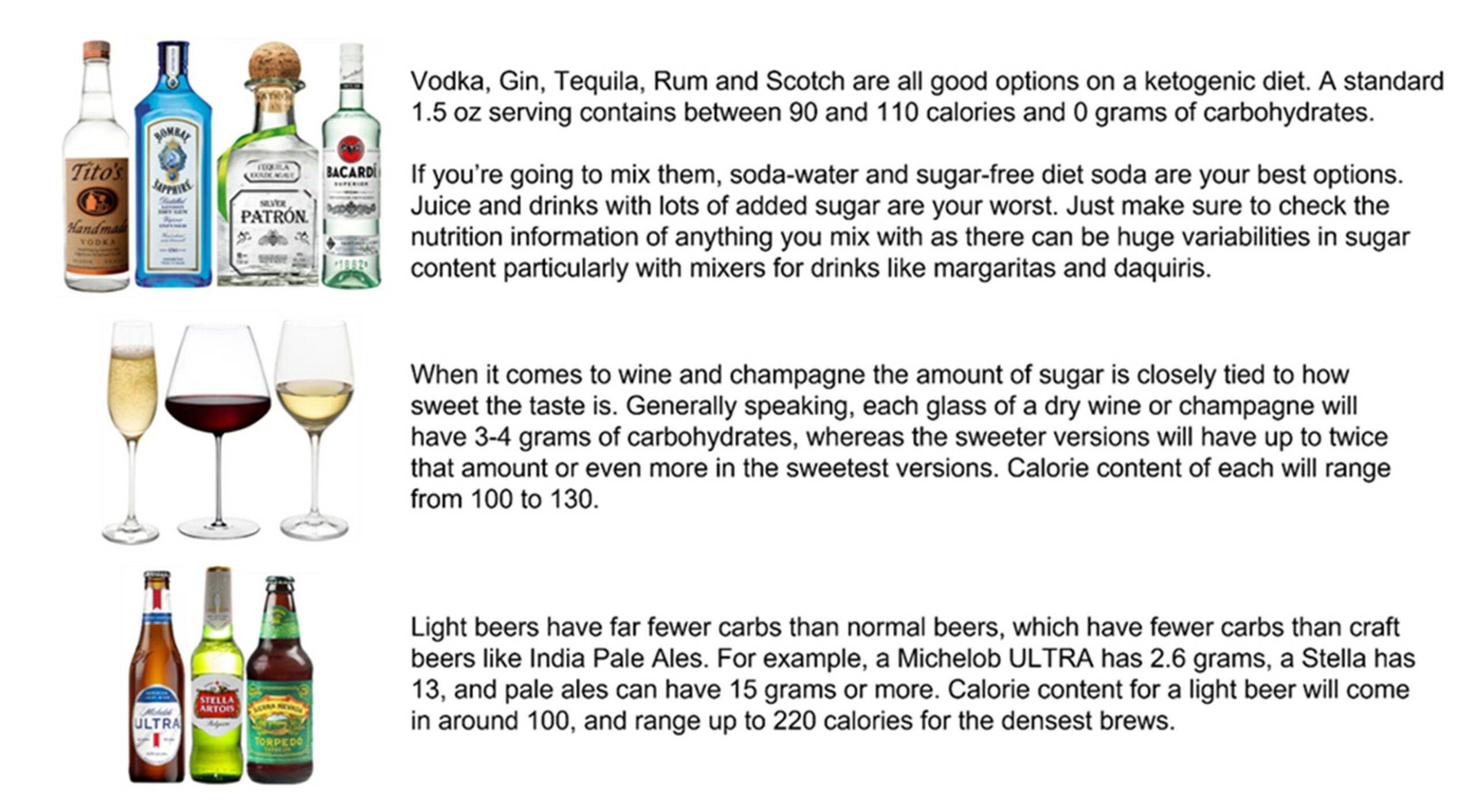 Reference sheet comparing spirits, wine and beer, with serving-size and carbohydrate information. Open full-size image
References
-
Cederbaum AI. ALCOHOL METABOLISM. Clin Liver Dis. 2012;16(4):667-685. doi:10.1016/j.cld.2012.08.002
-
Shelmet JJ, Reichard GA, Skutches CL, Hoeldtke RD, Owen OE, Boden G. Ethanol causes acute inhibition of carbohydrate, fat, and protein oxidation and insulin resistance. J Clin Invest. 1988;81(4):1137-1145.