
Metabolic syndrome is not a single disease. It is a group of related warning signs that tend to appear together and increase the risk of type 2 diabetes, cardiovascular disease, stroke, fatty liver disease, and other health problems.
The five commonly recognized components are:
- A larger waist circumference, which can reflect excess visceral fat around the abdominal organs
- Elevated blood pressure
- Elevated fasting blood glucose
- Elevated triglycerides
- Low HDL cholesterol
A person is generally considered to have metabolic syndrome when at least three of these five criteria are present.[1] The individual numbers matter, but the pattern matters even more. High blood sugar, elevated triglycerides, low HDL cholesterol, high blood pressure, and visceral fat often point toward an underlying problem with insulin resistance and the way the body stores and uses energy.
Many people have no obvious symptoms. The first clue may be a change in a routine blood test, a rising blood pressure, an expanding waistline, prediabetes, or fatty liver found on imaging.
Metabolic health is not defined by body weight alone
Metabolic syndrome is common, but it is not inevitable. A national analysis published in 2019 found that only 12.2% of American adults met a strict definition of optimal metabolic health. In other words, nearly 88% had at least one important metabolic abnormality.[2]
Body weight can be part of this picture, especially when weight is concentrated around the abdomen. It is not the whole picture. People at a higher body weight can improve blood pressure, glucose regulation, triglycerides, HDL cholesterol, and liver fat. People at a lower body weight can also have insulin resistance or other features of metabolic syndrome.
This is why the goal is not simply to make the scale move. The goal is to improve the health signals underneath it.
Why triglycerides and HDL are important
Triglycerides are a form of fat carried in the blood. They commonly rise alongside insulin resistance, poor glycemic control, excess alcohol intake, and a diet rich in refined carbohydrates and added sugars. Low HDL cholesterol often travels with the same metabolic pattern.
Very high triglyceride levels deserve urgent medical attention because they can increase the risk of pancreatitis. Treatment must be individualized, and medication may be necessary. Dietary change can also be powerful in selected patients under medical supervision.
Toward Health research on severe hypertriglyceridemia
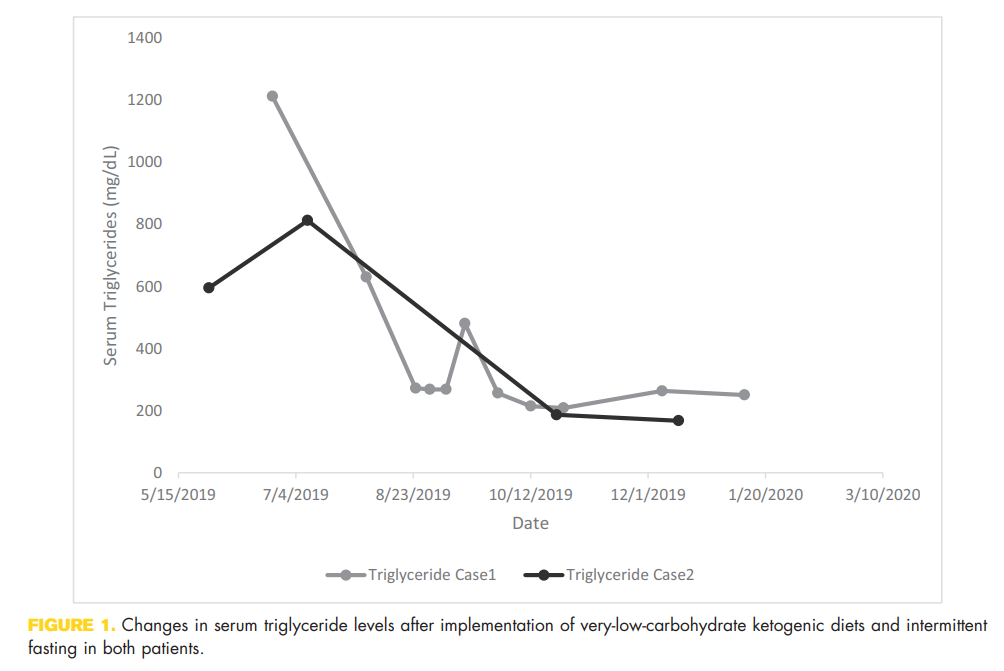
Toward Health clinicians reported two patients with severe hypertriglyceridemia whose triglyceride levels fell substantially after implementing a very-low-carbohydrate ketogenic diet and intermittent fasting.[3] This case series is clinically notable, but it includes only two patients. It should be viewed as hypothesis-generating evidence, not proof that the same approach is appropriate or sufficient for everyone.
Research also suggests that elevated triglycerides may affect insulin and leptin signaling in the brain, which could help connect metabolic syndrome with appetite regulation.[4] This is an emerging area of research and does not mean that triglycerides alone determine hunger or eating behavior.
Can metabolic health improve before major weight loss?
Weight loss often improves the components of metabolic syndrome. The original article also highlighted an important question: can changing the composition of the diet improve metabolic markers even before meaningful weight loss occurs?
In a controlled feeding trial, adults with metabolic syndrome consumed three diets that contained the same number of calories but differed in carbohydrate content. The low-carbohydrate phase improved several features of metabolic syndrome even though the participants did not lose substantial weight.[5]


The study found improvements in triglycerides, HDL cholesterol, blood pressure, fasting glucose, and other metabolic measures during carbohydrate restriction.[5] It provides evidence that metabolic markers can improve independently of major weight loss. It does not prove that weight loss is unimportant, or that every person will respond in the same way.
The practical message is encouraging: you do not have to wait until you reach a particular goal weight to begin improving your health.
What newer research adds
A 2026 randomized clinical trial examined adults with metabolically unhealthy obesity, prediabetes, and hepatic steatosis who lost approximately 10% of their body weight using one of three diets: a very-low-carbohydrate ketogenic diet, a Mediterranean diet, or a very-low-fat plant-forward diet.[6]
All three groups improved muscle insulin sensitivity by roughly 50%, which reinforces the metabolic value of meaningful weight loss. However, the very-low-carbohydrate ketogenic group experienced a two- to three-fold greater improvement in hepatic insulin sensitivity and larger reductions in liver fat, hepatic fat production, HbA1c, and 24-hour glucose and insulin levels than the other groups.[6]
There were no between-group differences in LDL cholesterol, apolipoprotein B, or 24-hour triglyceride concentrations.[6] These results suggest that macronutrient composition may influence some metabolic outcomes beyond matched weight loss, particularly in the liver. The trial was relatively small, 42 participants completed it, and it studied a closely supported population with prediabetes and fatty liver. It does not establish long-term cardiovascular outcomes or prove that a ketogenic diet is the best choice for every person.
What the broader low-carbohydrate evidence shows
The original Disciple article included several studies comparing low-carbohydrate and low-fat diets:
- A meta-analysis of randomized trials found that low-carbohydrate diets generally produced greater reductions in triglycerides and greater increases in HDL cholesterol than low-fat diets, although both approaches could support weight loss and risk-factor improvement.[7]
- A calorie-controlled trial found more favorable changes in several metabolic-syndrome markers with carbohydrate restriction than with a low-fat diet.[8]
- A later meta-analysis found that lower carbohydrate intake and higher protein and fat intake were associated with greater weight loss across the included trials. The authors also examined changes in metabolic-syndrome markers.[9]
These findings support therapeutic carbohydrate reduction as one evidence-based option. They do not make it the only effective dietary approach. Food quality, protein adequacy, sleep, stress, physical activity, medications, alcohol intake, smoking, genetics, and the ability to sustain a plan all matter.
Toward Health's real-world metabolic-health intervention
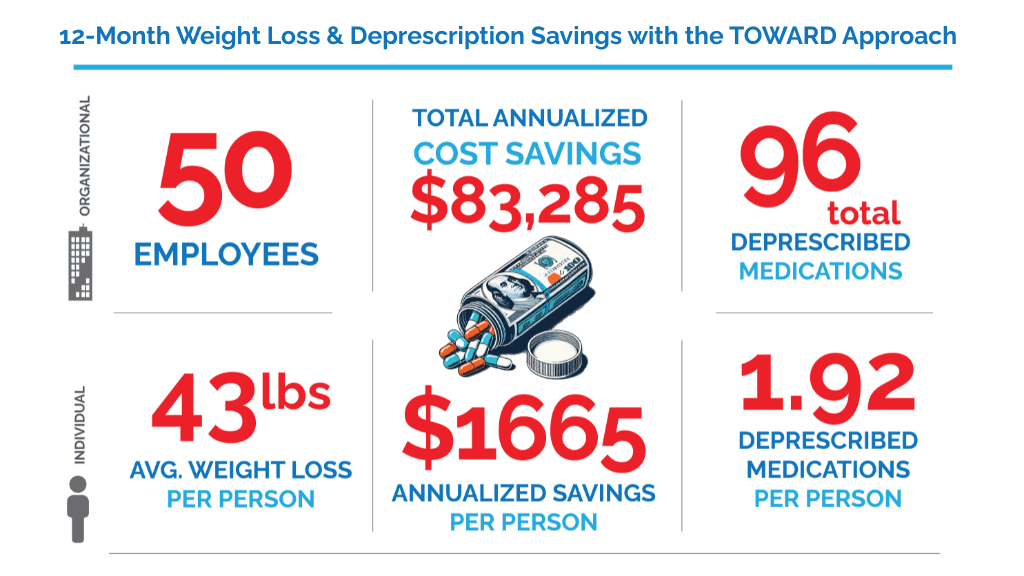
A 2025 Toward Health study followed 50 employees who entered a multimodal telemedicine metabolic-health program. The program combined therapeutic carbohydrate reduction with coaching, education, community support, remote monitoring, and individualized medical care.[10]
At one year, the intention-to-treat analysis showed an average total body weight loss of 15.5%. The care team deprescribed 96 medications and started 8 medications during the study period.[10]
These results are promising, but they require context. This was a real-world, nonrandomized cohort without a control group. Participants self-selected into the program, and the intervention had several components, so the study cannot show how much of the outcome came from carbohydrate reduction, coaching, monitoring, medical care, community support, or the interaction among them.[10]
The study does show what can be achieved in a supported clinical setting. It should not be interpreted as a guarantee of a particular amount of weight loss or medication reduction.
What improvement can look like
Metabolic syndrome is not necessarily permanent. With effective treatment, a person may improve enough that they no longer meet the diagnostic criteria. Depending on the individual, improvement may include:
- Lower fasting glucose or HbA1c
- Lower triglycerides
- Higher HDL cholesterol
- Lower blood pressure
- Reduced waist circumference or visceral fat
- Less liver fat
- Fewer or lower doses of medications when clinically appropriate
It is reasonable to describe this as improvement or, when the formal criteria are no longer met, resolution of metabolic syndrome. The word reversal should be used carefully. It does not mean that future risk disappears or that treatment and monitoring are no longer necessary.
Where to begin
A useful starting point is to understand your current numbers and choose changes that can be sustained:
- Review your blood pressure, fasting glucose, HbA1c, triglycerides, HDL cholesterol, waist circumference, medications, and relevant liver testing with a clinician.
- Reduce added sugars and refined carbohydrates. Some people may benefit from a more structured low-carbohydrate or ketogenic approach.
- Prioritize adequate protein and minimally processed foods that support fullness and preserve muscle.
- Include resistance training, walking, and other movement appropriate for your health and ability.
- Address sleep, stress, alcohol intake, smoking, and other factors that can worsen metabolic risk.
- Monitor your response and adjust the plan with your healthcare team.
People taking insulin, sulfonylureas, blood-pressure medications, or other medicines affected by dietary change should not begin a restrictive diet or fasting regimen without clinical guidance. Glucose and blood pressure can improve quickly, and medication doses may need to be adjusted to prevent adverse effects.
The encouraging point is not that there is one perfect diet. It is that the components of metabolic syndrome are measurable and often modifiable. Improvement can begin before a person reaches a final weight goal, and the best plan is the one that produces meaningful health changes safely and sustainably.
Companion video
References
- Alberti KGMM, Eckel RH, Grundy SM, et al. Harmonizing the Metabolic Syndrome: A Joint Interim Statement of the International Diabetes Federation Task Force on Epidemiology and Prevention; National Heart, Lung, and Blood Institute; American Heart Association; World Heart Federation; International Atherosclerosis Society; and International Association for the Study of Obesity. Circulation. 2009;120(16):1640-1645. https://doi.org/10.1161/CIRCULATIONAHA.109.192644
- Araújo J, Cai J, Stevens J. Prevalence of Optimal Metabolic Health in American Adults: National Health and Nutrition Examination Survey 2009-2016. Metabolic Syndrome and Related Disorders. 2019;17(1):46-52. https://doi.org/10.1089/met.2018.0105
- Das S, McCreary J, Shamim S, Kalayjian T. Reversal of Severe Hypertriglyceridemia With Intermittent Fasting and a Very-Low-Carbohydrate Ketogenic Diet: A Case Series. Current Opinion in Endocrinology, Diabetes and Obesity. 2020;27(5):308-311. Original PubMed record. https://doi.org/10.1097/MED.0000000000000566
- Banks WA, Farr SA, Salameh TS, et al. Triglycerides Cross the Blood-Brain Barrier and Induce Central Leptin and Insulin Receptor Resistance. International Journal of Obesity. 2018;42(3):391-397. https://doi.org/10.1038/ijo.2017.231
- Hyde PN, Sapper TN, Crabtree CD, et al. Dietary Carbohydrate Restriction Improves Metabolic Syndrome Independent of Weight Loss. JCI Insight. 2019;4(12):e128308. https://pubmed.ncbi.nlm.nih.gov/31217353/
- Petersen MC, Smith GI, Farabi SS, et al. Effect of Diet Macronutrient Content on the Cardiometabolic Response to Weight Loss: A Randomized Clinical Trial. Cell Metabolism. Published online August 27, 2026. https://doi.org/10.1016/j.cmet.2026.07.020
- Nordmann AJ, Nordmann A, Briel M, Keller U, Yancy WS Jr, Brehm BJ, Bucher HC. Effects of Low-Carbohydrate vs Low-Fat Diets on Weight Loss and Cardiovascular Risk Factors: A Meta-Analysis of Randomized Controlled Trials. Archives of Internal Medicine. 2006;166(3):285-293. https://pubmed.ncbi.nlm.nih.gov/16476868/
- Volek JS, Phinney SD, Forsythe CE, et al. Carbohydrate Restriction Has a More Favorable Impact on the Metabolic Syndrome Than a Low Fat Diet. Lipids. 2009;44(4):297-309. https://pubmed.ncbi.nlm.nih.gov/19082851/
- Willems AEM, Sura-de Jong M, van Beek AP, Nederhof E, van Dijk G. Effects of Macronutrient Intake in Obesity: A Meta-Analysis of Low-Carbohydrate and Low-Fat Diets on Markers of the Metabolic Syndrome. Nutrition Reviews. 2021;79(4):429-444. Original journal record. https://doi.org/10.1093/nutrit/nuaa044
- Buchanan L, Calkins M, Kalayjian T, et al. TOWARD, a Metabolic Health Intervention, Demonstrates Robust 1-Year Weight Loss and Cost-Savings Through Deprescription. Frontiers in Nutrition. 2025;12:1548609. https://doi.org/10.3389/fnut.2025.1548609