
A fasting schedule should fit your life and your appetite. This guide explains the common approaches and the questions our team hears most often.
It is important to understand that most people can use planning and willpower to stop eating for only a finite period of time. At some point, the appetite will kick-in. This is the main eventual side-effect of fasting; an eventual increase in hunger and appetite when you're presented with food. Eventually most people will at some point "fail" at fasting, even when it's prescribed by a doctor. In fact, research shows that most people are only able to fast 3-5 days per week even when prescribed a daily intermittent fast regimen. This is actually in-line with how many days the average patient would take a daily multivitamin. So what does this mean for us? In our practice, we care more about what our patients do when they break their fast, rather than their ability to fast.
In summary, given that hunger is the main side-effect of fasting, it's important to be able to advocate for your appetite and hunger with satiating food. If you fast without understanding how to eat in a healthy way, you may be setting yourself up for failure. First, learn to eat by cultivating a mastery of your hunger and appetite. Only when your hunger is decreased should you progress to intermittent fasting.
We ask patients to think defensively when beginning a fasting regimen — what will you do if you get really hungry during your fast? If you cannot answer this question, it is likely you shouldn't jump in quite yet. Furthermore, when you begin intermittent fasting, have patience and start flexibly. If you know you have early dinner plans, consider delaying breakfast and/or lunch since you know you will be having an early dinner. If you get hungry earlier in the day, try eating breakfast and lunch and then skipping dinner.
In our clinical practice, we have found these two qualities critical for success with fasting: remaining flexible and thinking defensively. As you learn about various fasting regimens, always remember this; our practice cares more about what you do when you decide to break your fast, rather than your ability to forgo eating.
We generally reinforce with our patients the concept that fasting is truly an expression of non-hunger. In other words, fasting is literally just exercising the state of not being hungry and not being triggered to eat. More often than not, we find that a restrictive, regimented approach to fasting can often lead to feeling unsuccessful. When starting a fasting protocol you will hear our coaches recommend simply delaying your first meal by utilizing some extra water, coffee, tea or seltzer and to proceed comfortably and particularly in a safe environment. Experimenting with intermittent fasting into a business meeting where you will face pizza and muffins may not be a great plan. If you start slowly and safe, you will find that as you get comfortable delaying meals, fasting will become easier and easier over time. Initially, our patients cannot imagine the idea of eating one meal in a day. However, by the end of our program they find the OMAD approach is easily attainable once their appetite is managed. The ideal fasting strategy is to start early and end early. Late-night eating has been consistently found to worsen overall health. But we believe that any time-restriction is better than none.
The Science of Fasting with Dr. Laura Buchanan · Explore the full 52-minute lecture.
Common fasting schedules
Here is how the different fasting schedules work.
What is intermittent fasting (IF)?
Intermittent fasting is not a diet, but rather a schedule of eating in which you have periods of eating and not-eating, i.e. a fed state and a fasted state. During the fasted state, your insulin levels are low and your body burns stored glucose and then its own fat stores for energy. 
What is Time-Restricted Eating (TRE)?
Eating within a selected time frame. TRE is a form of intermittent fasting, with a number of different protocols. The exact hours you choose to have as your eating window are entirely up to you; choose what works for your schedule and lifestyle. We often recommend timing your eating window with the time of day you are hungriest.
16:8
Eating is restricted to an 8 hour window so that you are fasting for 16 hours. This usually involves skipping one meal, typically breakfast. (Ex.: Eat lunch at 12pm, finish dinner at 8pm, do not eat again until 12pm the next day.)
18:6
Eating is restricted to a 6 hour window and fasting for 18 hours. This usually involves skipping one meal, typically breakfast, and delaying lunch for a few hours. (Ex.: Eat lunch at 12pm, finish dinner at 6pm, do not eat again until 12pm the next day.)
Alternate Day Fasting
Fast one day, eat the next.
5:2
Two days a week eat around 500 calories, and then five days a week eat normally (preferably a low-carb/ketogenic diet). This is considered a version of Alternate Day Fasting.
One Meal A Day (OMAD)
As the name implies, this involves eating one meal a day. Many of the people we work with land somewhere around 1.5 meals a day; this means some days it’s one meal, other days it’s two, and then some days it’s one small meal and a larger one. Average? 1.5 meals a day.
Extended Fasting (EF)
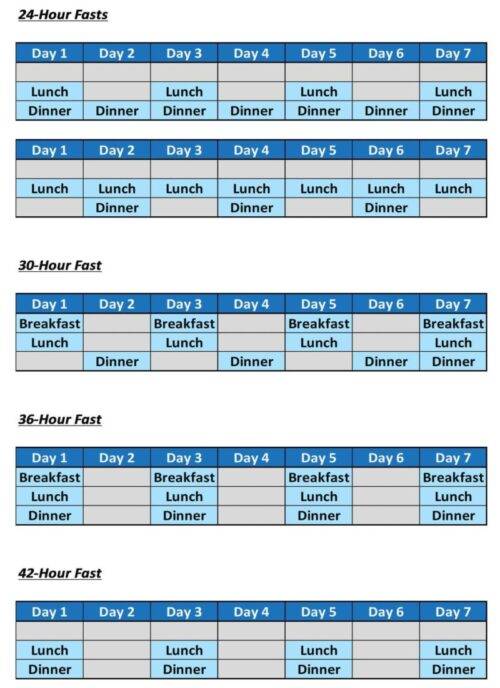
This refers to any fast over 24 hours (commonly 36, 42 or 48 hours, but sometimes longer). We typically do not recommend extended fasts. Occasional EF (once a week or month) can be helpful based on your progress.
Protein-Sparing Modified Fast (PSMF)
This is a protocol that has been around for a while, but has only been gaining popularity lately. It cycles between eating a very high lean protein, low fat, very low carb diet for 2-3 days and then switching it up with a traditional high(er) fat ketogenic diet for a few days.
Let's now answer some of the most common questions we face about fasting.
Is fasting okay for women?
Fasting is safe and effective for women. Excessively restrictive diets are not. If someone restricts excessively on any diet it can cause irregularities. Studies have not shown that any one diet causes more problems than another.
I don’t think I can make it a full 16 hours fasted. What should I do
It is best not to try fasting until you have been on a low carb diet for at least 4-6 weeks. If you’re not ready, don’t be overly aggressive and set yourself up for failure. Eventually, if you are not too hungry for breakfast, delay your first meal of the day by just 15-30 minutes – whatever feels doable. Get used to that for a few days and then add on another 15-30 minutes. Drink a giant glass of water and see if you can push that first meal as long as possible. Fasting should be a gradual and painless process; there is no need to make it complicated or overly burdensome.
Why are a low carb or ketogenic diet and fasting often linked?
After about 4-6 weeks on a very low carbohydrate ketogenic diet, your blood ketone levels will hit their peak. With these ketones comes the ability of your body to burn fat for fuel, and also vitally important – the ability to go longer periods of time without being hungry. This appetite suppression is a big part of the “magic” of a ketogenic diet: you can more easily and naturally eat less without being hungry.
Fasting is the result of a reduced appetite. This is why it often comes in tandem with a ketogenic diet. It might not be easy, but fasting shouldn’t feel terribly hard either. That being said, there will still be lots of reasons that you want to eat: it’s 12pm and you’ve eaten at this time for your entire life…you’re stressed/tired/depressed/happy and want a reward/distraction…you’ve eaten something carb-heavy recently and blood sugar fluctuations are leaving you with hunger and cravings…or simply the food your family/friends/co-workers are eating looks/smells good.
What is considered ok to eat/drink during your fasting state? What "breaks" a fast?
Generally speaking, during a fast you want to stay hydrated and drink plenty of water, seltzer, coffee and tea. Bone broth can also be helpful to drink during your fast. Make sure to supplement with salt and electrolytes.
If you use (no-sugar) sweetener, cream, milk or plant-based creamers in your coffee, these will “officially'' break your fast. However don’t worry about that if you’re early on in the process. Instead, work to taper down on the amount you put in your coffee/tea, slowly lowering the quantity so it’s a painless process.
Many people ask us about Bulletproof Coffee (BPC). This is a brand name for a coffee, but most refer to it as a coffee with MCT oil, butter/ghee and any number of other fat sources that are emulsified to create a latte-like froth. This can be initially effective to get you out of the habit of eating breakfast (as a meal replacement). However, drinking 500 calories of fat is not ideal so we almost always recommend people stop these after a little while. If you’re drinking BPC to lower your food intake, your best bet is to instead stick to real, whole foods. Half a dozen eggs offers the same energy as the average BPC, gives a lot more nutrition, and will likely keep you full for much longer.
I am so hungry. What should I do?
Hunger is often transitory – it comes and goes – so buy yourself some time. Try to fill your stomach with water, coffee, tea or seltzer, switching up the flavor profiles of the liquid you’re drinking every half hour or so and see if the hunger passes. Often we mistake thirst, a growling stomach or the desire to eat as a sign of hunger. However, it is not. True hunger is when you are willing to eat plain, dry tuna from a can or a hard-boiled egg. If the cheese and salami in the fridge or a handful of nuts are calling to you, it’s safe to say you want to eat, but it doesn’t have much to do with “true” physical hunger.
If you are uncomfortably hungry and the tactics you’ve tried have not lessened it, the solution is simple: eat. Keep it low-carb, make it a meal, not a snack and (without judgment) move on.
I am bored, have cravings or just plain want to eat – but I’m not really hungry.
Do your best to distract yourself – get out of the house, go for a walk, play with your kids/dog, clean out a drawer or watch a TV show – anything to buy yourself some time. Drink a big glass of water, coffee, tea or seltzer and remember your “why.” Eating out of boredom is a habit, and often cravings subside after a few minutes. Do your best to ride it out.
Is it ok to exercise while fasting?
Yes! Make sure to stay hydrated and supplement with electrolytes.
What do I eat when I’m not fasting?
Sticking to low-carb when you’re not fasting will help make fasting easier. By doing so, you avoid the big glycemic shifts that occur from eating a diet high in carbs which results in hunger and cravings. Eat foods that are satiating and don’t leave you hungry for more.
When should I end a fast earlier than planned?
If you are hydrated and have had electrolytes and are uncomfortably hungry, light-headed and/or not feeling well, it is wise to end your fast earlier than planned. While fasting is not always easy, it should not be painful or so difficult that you can’t concentrate on work/life or be unable to sleep.
Don’t I need to eat breakfast or 4-6 small meals a day to rev my metabolism?
No! This is a false narrative most likely created by the industries that profit from all of us eating breakfast and/or many meals a day.
Do I need to eat more when I’m not fasting? Will my metabolism slow down if I don’t eat enough?
Eat only to satiety during your eating window, not significantly more. This can take some trial and error as the inclination will be to overeat “while you have the chance.” There is no need to “stock up” on food during your eating window. If you are not feeling well (light-headed, constipated, chronically cold, etc.), you may not be eating enough so talk to your doctor about how to proceed.
I’m wearing a CGM/testing blood sugar – why does it go up when I am fasting?
If you’re testing your blood sugar while fasting, you may be surprised to see that it goes up even though you have not eaten anything. When fasting, your insulin levels will be down and stored glucose will be released from your liver. In layman’s terms – your body is giving you the energy you need to function during a fast.
How do I break my fast?
If you’ve done an extended fast, it is best to break your fast with some bone broth or something light, wait an hour and then have a meal. Sometimes reintroducing higher fat food after an extended fast can cause gastrointestinal issues, so it’s best to go slow until you learn how your body reacts. Always eat to satiety and try not to overeat because you have to “get it all in” during your eating window.
It just doesn’t feel normal not to eat (my family thinks I’m crazy/going to starve/kill myself with this “crazy” diet).
Fasting is an ancient tradition and has been done by just about every culture/religion throughout history for one reason or another. It’s only been in recent history that we are presented with “eating opportunities” every few hours.
When you first start fasting, try to schedule it when you won’t need to feed your family or deal with questions/doubts from concerned loved ones. If you feel the need to offer anyone an explanation, tell them you are eating when you’re hungry and using your body fat for fuel. Or tell them to mind what’s on their own plate, not on yours. Most of the time people push back and object to things you’re doing because it sheds a light on the way they are living. Put blinders on and ignore the naysayers.
I am on medication or have a medical condition. What do I need to know? Should I discuss with my doctor?
ALWAYS discuss medication and any medical concerns you have with your doctor, particularly if you have diabetes or high blood pressure. Always talk with your doctor before you do any fasting. In the Toward Health app – there is a lecture on The Science of Fasting in the Metabolic Health course.
Sample fasting schedules here.
Nothing in this article is medical advice. Please consult with your doctor about any questions pertaining to your personal medical care.