
The American Academy of Pediatrics is right that growing children deserve caution. It is wrong about where it directs that caution.
Its 2023 clinical report treats low- and very-low-carbohydrate diets as choices that require exceptional caution in children with or at risk for diabetes. Meanwhile, a separate AAP obesity guideline supports earlier use of anti-obesity medication and referral for bariatric-surgery evaluation for qualifying adolescents. We believe that contrast deserves serious scrutiny.
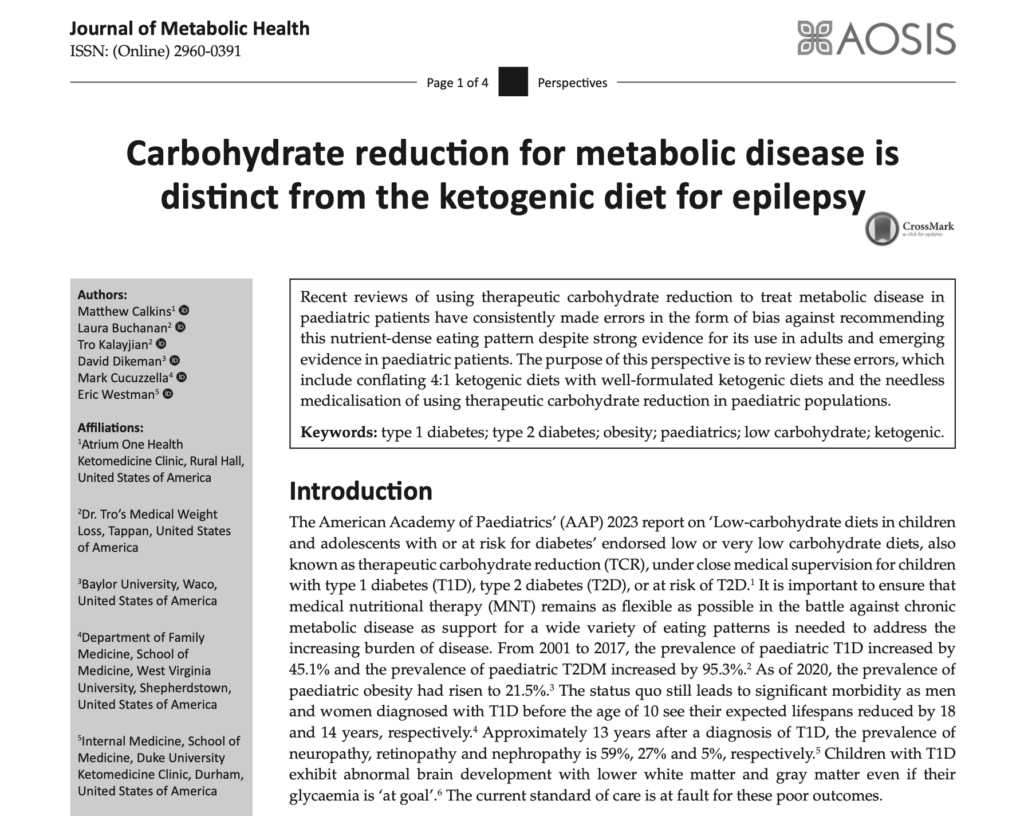
In a published perspective, Toward Health physicians Dr. Matthew Calkins, Dr. Laura Buchanan, and Dr. Tro Kalayjian joined colleagues in challenging the AAP’s position. They argue that the report mischaracterizes therapeutic carbohydrate reduction, gives disproportionate weight to potential harms, and fails to give equal weight to the consequences of persistent hyperglycemia and progressive metabolic disease.
Disclosure: Toward Health physicians coauthored the perspective discussed here, and Dr. Tro Kalayjian is both a coauthor of that paper and the medical reviewer of this article. The source paper is a published perspective—not a systematic review, clinical guideline, or clinical trial. This article is an editorial analysis of the evidence, not independent news coverage.
What the AAP Says—and Why We Object
First, the AAP report is more nuanced than the headlines it generated. It recommends minimizing highly processed foods, refined grains, and added sugars, and eliminating sugar-sweetened beverages. It also distinguishes among several levels of carbohydrate intake:
- Typical recommended range: 45% to 65% of energy from carbohydrate
- Moderate carbohydrate restriction: 26% to 44% of energy
- Low carbohydrate: less than 26% of energy
- Very low carbohydrate: approximately 20 to 50 grams per day
- Ketogenic: less than 20 grams per day
The report acknowledges clinical support for a lower-carbohydrate intake of 26% to 40% of energy when a young person and family choose it and have medical supervision. For lower intakes, however, its framing becomes far more cautionary, emphasizing possible nutrient deficiencies, slowed growth, poor bone health, disordered eating, hypoglycemia, and ketosis. Its detailed monitoring table is directed at very-low-carbohydrate and ketogenic patterns—not every diet below 45% carbohydrate—and any fair criticism must preserve that distinction.
Some caution is appropriate. Children are growing, and type 1 diabetes makes unsupervised dietary and insulin changes dangerous. Our objection is not to monitoring. It is to treating therapeutic carbohydrate reduction as presumptively suspect while presenting medication and surgical evaluation as reasonable, evidence-based tools in a separate obesity guideline. The AAP recommends pharmacotherapy for adolescents 12 and older with obesity when indicated, as an adjunct to health behavior and lifestyle treatment. It recommends referral for bariatric-surgery evaluation for adolescents 13 and older with severe obesity. Those are eligibility-specific recommendations, not blanket prescriptions, but they expose a striking inconsistency in how risk and uncertainty are framed.
Therapeutic Carbohydrate Reduction Is Not an Epilepsy Diet
“Low carbohydrate” is not one diet. A moderately carbohydrate-reduced pattern built around protein, nonstarchy vegetables, healthy fats, and minimally processed foods is not the same intervention as the strict ketogenic diets historically used to treat epilepsy.
A classic epilepsy diet may use a 4:1 ratio of fat to protein plus carbohydrate and is designed to produce sustained therapeutic ketosis. A well-formulated therapeutic carbohydrate-reduction plan for metabolic disease can be less restrictive, more protein-forward, and individualized to a child’s diagnosis, medications, growth, activity, culture, preferences, and family circumstances.
That distinction matters because the risks, benefits, nutritional requirements, and level of monitoring depend on the actual intervention. Warnings drawn from highly restrictive epilepsy protocols should not be casually transferred to every lower-carbohydrate eating pattern. A diet’s nutritional quality comes from what it contains, not from a carbohydrate percentage viewed in isolation.
The Evidence Does Not Justify This Double Standard
Long-term pediatric trials of carbohydrate restriction are limited. That is a legitimate gap, and it should be stated plainly. But limited evidence is uncertainty, not proof of harm. It does not justify treating one option as uniquely hazardous while applying a more permissive standard to other interventions that also carry risks, burdens, and unanswered long-term questions.
In their published response, Calkins and colleagues argue that the AAP report repeatedly blends evidence from strict ketogenic diets with evidence about broader therapeutic carbohydrate reduction. They also argue that weaknesses in the evidence for conventional dietary patterns receive less attention than weaknesses in the evidence for carbohydrate-reduced approaches.
This does not mean medication or surgery should be withheld when clinically appropriate. Both can be valuable, and sometimes necessary. It means nutrition should receive the same intellectually honest risk-benefit analysis. Families deserve to hear what is known, what is not known, and how each option compares with the real risks of the condition being treated.
The Risks of Doing Nothing Are Not Theoretical
The status quo is not benign. The National Center for Health Statistics estimates that 21.1% of U.S. children and adolescents ages 2 to 19 had obesity in August 2021 through August 2023, including 7.0% with severe obesity.
Diabetes is also becoming more common in young people. In the SEARCH for Diabetes in Youth study, estimated type 1 diabetes prevalence increased 45.1% and type 2 diabetes prevalence increased 95.3% between 2001 and 2017. Those figures are relative increases in prevalence across six U.S. study areas, not national incidence rates. Even with that important limitation, the direction is difficult to dismiss.
Persistent hyperglycemia and progressive metabolic disease have consequences. When conventional advice is not producing adequate results, repeating it indefinitely is not a neutral act. The risks of additional dietary options should be compared with the risks of leaving diabetes, obesity, insulin resistance, and their complications inadequately addressed.
What Newer Clinical Trials Actually Show
Evidence published after the AAP report does not settle every question, but it makes categorical dismissal harder to defend.
A six-month, open-label randomized trial assigned 40 participants ages 12 to 22 with type 1 diabetes, with a median age of 18, to a low-carbohydrate or Mediterranean diet. Both groups improved. The prespecified between-group difference in the change in continuous-glucose-monitor time in range was not statistically significant. The low-carbohydrate group did have a greater reduction in HbA1c and spent less time above 250 mg/dL, while changes in BMI z-score and lipids were similar. No severe hypoglycemia or diabetic ketoacidosis was reported, but the study was small, included young adults, and was too short to answer long-term questions about growth or development.
A separate randomized crossover trial provided calorie-matched controlled meals to 35 children and young people with type 1 diabetes, whose average age was 14.5 years. During five weeks at roughly 95 grams of carbohydrate per day, participants spent 3.3 percentage points more time in range and had less hyperglycemia than during five weeks at roughly 191 grams per day. Time in hypoglycemia, LDL cholesterol, glycemic variability, and self-reported quality of life did not differ significantly.
These trials are promising, not definitive. They do not establish the long-term safety of every low-carbohydrate diet for every child. They do show why the evidence should be updated rather than frozen at the most cautionary interpretation available in 2023.
Children and Families Deserve Informed Clinical Choice
There should be no one-size-fits-all pediatric diet. A responsible plan must consider diagnosis, medications, nutritional adequacy, growth, puberty, physical activity, mental health, food access, family preferences, and the young person’s willingness to participate.
When therapeutic carbohydrate reduction is considered, good clinical care should include:
- enough energy, protein, essential fats, fiber, vitamins, and minerals for growth and development;
- ongoing assessment of height, weight, growth velocity, puberty, laboratory markers, and overall well-being;
- screening for disordered eating and attention to the child’s relationship with food;
- a clear distinction between moderate, low, very-low-carbohydrate, and ketogenic approaches; and
- close coordination with the pediatric diabetes team whenever insulin or another glucose-lowering medication is involved.
Blanket discouragement can damage trust and drive families to make changes without telling their clinicians. A better response is informed choice, honest uncertainty, careful monitoring, and shared decision-making. That is not reckless. It is what patient-centered medicine is supposed to look like.
Read Our Published Response
The full perspective, Carbohydrate reduction for metabolic disease is distinct from the ketogenic diet for epilepsy, was published in the Journal of Metabolic Health in 2024.
Sources and further reading
- AAP clinical report: Low-Carbohydrate Diets in Children and Adolescents With or at Risk for Diabetes
- AAP Clinical Practice Guideline for the Evaluation and Treatment of Children and Adolescents With Obesity
- Calkins et al.: Carbohydrate reduction for metabolic disease is distinct from the ketogenic diet for epilepsy
- Six-month randomized trial of low-carbohydrate and Mediterranean diets in adolescents and young adults with type 1 diabetes
- Five-week randomized crossover trial of a low-carbohydrate diet in children and young people with type 1 diabetes
- CDC/NCHS: Prevalence of overweight, obesity, and severe obesity among U.S. children and adolescents
- SEARCH for Diabetes in Youth: Trends in prevalence of type 1 and type 2 diabetes, 2001 to 2017
Medical note: This article is an analysis of published guidance and research, not individualized medical advice. Children and adolescents with diabetes should not materially change carbohydrate intake, insulin, or other glucose-lowering medication without their pediatric diabetes team.