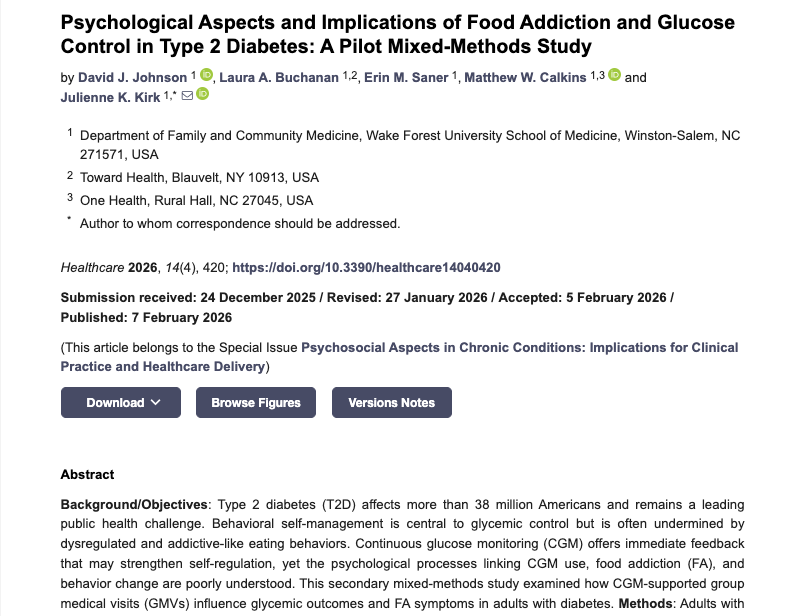

February, 2026 – TOWARD Health physician Dr. Laura Buchanan, MD, recently co-authored a study published in the journal Healthcare titled Psychological Aspects and Implications of Food Addiction and Glucose Control in Type 2 Diabetes: A Pilot Mixed-Methods Study.¹ The research examines the impact of lifestyle interventions on compulsive eating behaviors in individuals with type 2 diabetes. As Dr. Buchanan explains, “It is not only possible, but demonstrably effective, to address the underlying drivers of compulsive eating through empathetic, lifestyle-focused interventions.”
Personalized, Patient-Centered Care is Transforming Outcomes
What if the breakthroughs in healthcare weren’t only about the latest new drug or device, but about a smarter way to deliver care? Dr. Buchanan’s latest study highlights a powerful reality: modern, patient-centered, technology-enabled care models are transforming outcomes, efficiency, and patient experience at the same time.
Healthcare That Meets Patients Where They Are
The research shows that integrating digital tools, proactive monitoring, and coordinated care doesn’t just make healthcare more convenient, it makes it more effective. Key study takeaways:
- Clinical outcomes improved through earlier intervention and continuous follow-up
- Greater patient engagement and adherence was driven by accessible, personalized support
- Better care coordination, reduced gaps, duplication, and delays
This study shows that when care becomes continuous instead of episodic, results improve.
Efficiency Without Sacrificing Quality
One of the most compelling findings is that modern, root-cause–focused care models benefit not only individual patients, but the broader healthcare system as well. The study demonstrated:
- Reduced healthcare utilization and costs through prevention and early action
- Streamlined workflows for clinicians
- More efficient use of resources without compromising care quality
This is the rare win-win for healthcare: better outcomes at lower system burden.
The Power of Personalization
A central theme of the research is that one-size-fits-all medicine is no longer enough, and programs that tailor care based on patient needs, risk profiles, and real-time data are associated with higher satisfaction, better self-management and more sustained health improvements. The message is clear: healthcare works best when it’s designed around the individual, not the system.
Why This Matters Now
As chronic disease, workforce pressures, and rising costs strain healthcare everywhere, this study points toward a more sustainable and hopeful direction, one grounded in preventive, proactive care, digital and remote support, team-based, coordinated delivery, and empowering patients as active partners. TOWARD Health’s Chief Medical Officer, Dr. Tro Kalayjian, “This study shows how we can move beyond merely managing disease to truly changing its trajectory. It’s not about adding additional layers of more complex care, but about delivering better care.”
The Bottom Line
When healthcare is continuous, coordinated, and personalized, the benefits extend to patients, providers, and the system as a whole. The future of healthcare is not defined by more treatment, but by smarter care, delivered earlier, centered on the individual, and informed by meaningful data and human connection. According to this study, that future is already within reach.
To read the full article, see it here: https://www.mdpi.com/2227-9032/14/4/420
- Johnson DJ, Buchanan LA, Saner EM, Calkins MW, Kirk JK. Psychological Aspects and Implications of Food Addiction and Glucose Control in Type 2 Diabetes: A Pilot Mixed-Methods Study. Healthcare. 2026; 14(4):420. https://doi.org/1.3390/healthcare14040420